
American accent
The heatwave started in June.
At first, people enjoyed it. The beaches were full. Cafés were busy. Tourists smiled and took photos.
Then the days became hotter.
Thirty-six degrees. Thirty-eight. Forty.
The weather forecast said, “More hot days are coming.”
People stayed inside. Air conditioners worked all day and all night. Fans never stopped.
After one week, the power cuts began.
Every evening, a different part of the island lost electricity for two hours.
Without power, homes became very hot. Food in fridges went bad. Children cried because they could not sleep.
Nobody knew when the next power cut would come.
People became tired. They were hot all day and could not sleep at night. Small problems quickly became big problems.
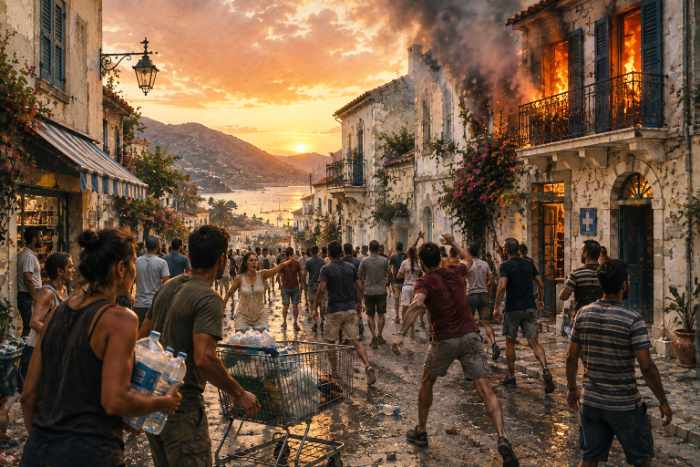
Soon, the supermarkets were full of worried people.
They bought water, candles, batteries and bags of ice.
Some shelves became empty before midday. Every morning there were longer queues outside the shops.
One afternoon, Maria was waiting to pay for two bottles of water.
A man pushed in front of her with a trolley full of bottles.
“You already have enough,” Maria said.
“They are for my family,” the man answered.
“So are these.”
“I was here first.”
The man did not move. Nobody said a word. The old woman behind Maria left the shop with nothing.
Outside, Maria saw another man selling small bags of ice from the back of his van. The price was three times higher than normal. People still bought them because they had no other choice.
The next day, two men fought over the last bag of ice.
One fell to the floor. The police came, but the ice was gone.
That night, someone stole fuel from a neighbour’s generator. The next night, another generator disappeared.
The local newspaper said there had also been two break-ins. People began to lock their gates before sunset. Some families stayed awake during the power cuts because they were afraid.
Neighbours stopped talking to each other. They stopped sharing food. They stopped sharing water.
Then a rumour started.
People said one street never had power cuts.
“The lights are always on,” someone said.
“They know people at the power station,” another person answered.
Others said rich people had paid for electricity while everyone else had to sit in the dark.
Soon everyone believed the story. Nobody asked if it was true.
One hot evening, the power went off again. Only one street stayed bright.
People came out of their houses. More people arrived every minute. Some wanted answers. Others just wanted someone to blame.
Someone shouted, “It isn’t fair!”
Another person picked up a stone.
The first window broke. Then another. People started running.
Someone hit a small electricity box near the road with a metal bar. There was a loud bang.
Suddenly, every light on the island went out. The bright street became dark too.
For a few seconds, there was only silence. Then someone shouted, “Fire!”
A broken window had knocked over a candle inside one of the buildings. Smoke was coming from the roof.
People ran towards the building. They carried buckets of water. Others helped old people come outside.
A nurse shouted for help. Two young men carried an old woman to safety. A father covered a child’s face with a wet towel because of the smoke.
After twenty minutes, the firefighters arrived. The fire was out, but part of the building was black.
The next morning, everyone learned the truth.
The building was not a rich family’s house. It was the island’s health centre.
The electricity stayed on there because sick people needed it.
The broken windows belonged to hospital rooms. The people inside were old, weak or ill.
Nobody had stolen electricity. Nobody had received special treatment.
The rumour was false.
Maria walked past the building that afternoon.
Workers were putting new glass into the windows. Police officers were asking questions. Nobody wanted to say who threw the first stone. Nobody wanted to say who hit the electricity box.
The heatwave ended three days later. The lights stayed on. Life slowly became normal again.
But every time Maria passed the health centre, she remembered one thing.
The heat had made the island hotter. Fear had made it dangerous.
📒 Key vocabulary
- heatwave – a long period of very hot weather
- forecast – information about what the weather will be like
- air conditioners – machines that make the air inside a building cooler
- power cuts – times when the electricity stops working
- candles – sticks of wax that give light when they burn
- queues – lines of people waiting for something
- trolley – a large cart used for carrying shopping
- fuel – petrol, diesel or another substance used to make a machine work
- generator – a machine that produces electricity
- gates – doors or barriers at the entrance to a house or garden
- sharing – giving part of something to another person
- blame – to say that someone is responsible for a problem or mistake
- knocked over (knock over, knocked over, knocked over) – make something fall to the ground by hitting it
- weak – not strong; easily hurt or tired
🤔 Comprehension quiz
How much of this story did you understand? Test yourself with this easyEnglish quiz!


Leave a Reply