
Level: A1

  • The New House

    The New House

    Sue and Greg were excited. They had just moved into a new house.

    “We are going to be so happy here,” said Sue. ‘’I feel so lucky.’’

    The house was big with large windows. The garden was green with tall trees. For Sue and Greg, it was perfect.

    But one thing was strange about the house. It had been empty for a long time. The neighbours said they could not remember the last people who lived there.

    Some said it had been empty for ten years.  Nobody was sure.

    “Maybe they just moved away,” Sue said.
    “Yes,” said Greg. “We don’t need to worry.”

    They worked hard to make the house feel like home. They painted the kitchen, cleaned the rooms, and bought new furniture. They were very happy.

    But sometimes, Sue thought the house was too quiet. She thought she heard small noises at night.

    A step on the stairs. A door moving. When she asked Greg, he said, “It’s only the wind.”

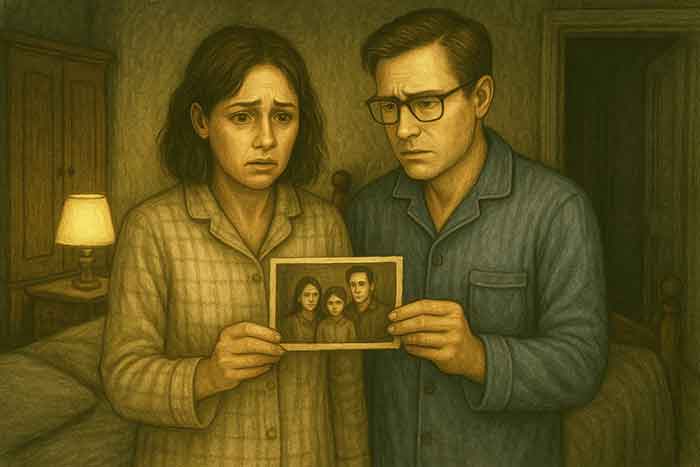
    One rainy afternoon, Sue was cleaning the cupboard in the living room. At the back, under an old book, she found something flat. It was a photo.

    “Greg,” she called.

    Greg came quickly. They looked at the photo together. It showed a family: a man, a woman, and a child.

    But the family did not look happy. They were not smiling. Their eyes looked dark.

    “This feels strange,” Sue said.

    Greg turned the photo over. On the back, the words were written in red. The words were not small. They were big and clear.

    “You’re next.”

    Greg dropped the photo on the floor. “What is this?” he asked.

    Sue felt cold. “Is it a joke?”

    But deep inside, she knew it was not a joke.

    They stood in silence. The room felt colder. The light outside grew darker.

    “Maybe we should leave,” Sue whispered.

    “No,” Greg said. ‘It’s just an old photo. Nothing more.”

    But that night, Sue could not sleep. She sat in bed, listening. The house was too quiet.

    Then she heard it: a step on the stairs. Slow. Heavy. Another step. And another.

    She touched Greg’s arm. “Do you hear it?” she asked.

    This time, Greg was awake. “Yes,” he said.

    They listened together. The steps came closer. Up the stairs. Down the hall. Stopping at their door.

    Slowly, the door moved.

    Greg jumped out of bed and opened it. But the hall was empty. Only the dark and the sound of rain on the windows.

    He turned back to Sue. “See? Nobody is there.”

    But Sue was looking at the floor. Her face was white.

    By her feet was the photo. The same photo she had found in the cupboard. But now, the picture had changed. The family was gone. The photo showed only two people: Sue and Greg.

    Terrified, Greg turned the photo over.

    The words were new. They said, “Now.”

    The light went on and off. The door closed loudly.

    And the house was quiet again.

    📒 Key vocabulary

    • excited – very happy and full of energy
    • empty – with nothing inside
    • furniture – things in a house like chairs, tables, and beds
    • step – the sound or movement when someone walks
    • cupboard – a piece of furniture with doors for keeping things
    • joke – something said to make people laugh
    • whispered – spoke very softly
    • awake – not sleeping
    • hall – a long space inside a house or building
    • terrified – very frightened

    🤔 Comprehension quiz

    How much of this story did you understand? Test yourself with this easyEnglish quiz!

  • The New Glasses

    The New Glasses

    Mike was an actor. People said he was handsome, and this made him happy.

    Mike spent a lot of time looking in the mirror. He also spent a lot of money on clothes and expensive shoes.

    But Mike had a problem. He could not see well.

    Mike went to the doctor. The doctor checked his eyes and gave him an eye test.

    “Mike”, the doctor said, “You need to wear glasses.”

    Mike was not happy.

    “No,” he said. “Glasses will make me look silly. Glasses are for old men.”

    One week later, Mike got his new glasses from the shop. He looked in the mirror and felt sad. Then he left the shop with the glasses on.

    As Mike walked home, he realised that he could see very well. The street, the cars, and the shops were clear. The colours were bright. The lights were strong.

    Mike saw a man with a bag walking in front of him. He saw the man drop the bag. But the man did not notice. Mike took off his glasses and tried to pick up the bag. 

    …but it wasn’t on the ground. It was still on the man’s arm. Mike felt confused.

    Two minutes later, the man really did drop the bag. This time it made a noise when it hit the ground. But the man didn’t notice. He continued walking.

    Mike picked the bag up and called to the man.

    “Excuse me,” he said. ’You dropped your bag.’’

    “Thank you,” said the man. ‘’

    ‘’No problem,’’ said Mike.

    Mike put his glasses on and continued walking.

    Then he saw a boy with a ball. With his glasses on, Mike saw the ball go into the road. The boy ran after it. A car was coming! Mike took off his glasses. The boy still had the ball in his hand. But then the ball went into the road again.

    Mike understood. With the glasses, he could see accidents before they happened.

    He ran to the boy and stopped him. Just then, a car passed and hit the ball. The boy was afraid, but he was safe. His mother said, “Thank you.”

    Mike walked on. He passed a café. He saw a woman with a cup of coffee sitting outside. With his glasses on, he saw the coffee fall off the table. It fell onto her legs.

    Then Mike took off his glasses. The coffee was still on the edge of the table.

    “Be careful with your coffee,” Mike said.

    The woman moved the cup.

    “Thank you,” she said. “You stopped my coffee from falling.”

    “No problem”, said Mike. ‘’I am happy to help.’’

    Mike walked home feeling good.

    He now knew he could help people if he wore his glasses.

    That night, Mike looked in the mirror and smiled. Perhaps wearing glasses wasn’t so bad, after all. 

    📒 Key vocabulary

    • actor – a person who plays in films, TV, or theatre
    • handsome – good-looking (usually for a man)
    • mirror – glass that shows you your face and body when you look at it
    • silly – not smart; not serious
    • drop – fall to the ground
    • ground – the land we walk on
    • passed – went by
    • edge – the line or place at the side of something

    🤔 Comprehension quiz

    How much of this story did you understand? Test yourself with this easyEnglish quiz!
  • The Red Umbrella

    The Red Umbrella

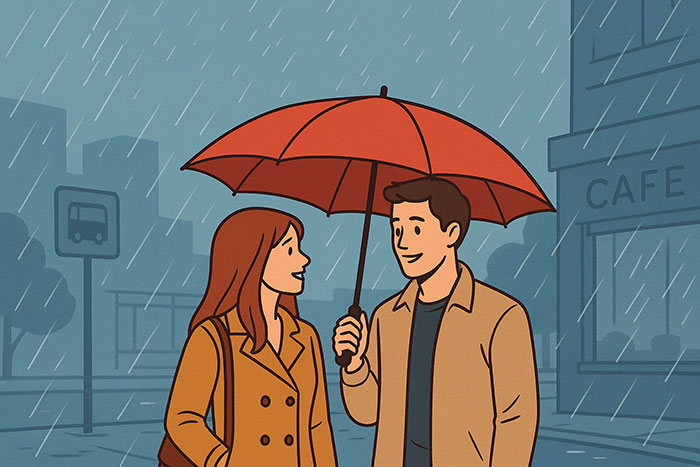
    It is raining in the city. Suzy waits at the bus stop. She has no umbrella. Her hair and coat are wet.

    A man comes. He has a big red umbrella. He smiles.
    “Would you like to share?” he asks.

    Suzy says, “Yes, thank you.” They stand close under the umbrella. The rain makes a soft sound.

    “What is your name?” the man asks.
    “Suzy,” she says.
    “I’m Tom,” he says.

    The bus comes, but it is full.
    “That’s okay,” says Suzy. “Let’s walk.”

    They walk together in the rain. They talk about music, books, and coffee. Suzy laughs. Tom laughs too.

    At the café, they sit by the window. The rain falls outside.

    Tom says, “I’m happy I came to the bus stop today.”

    Suzy smiles. “Me too.”

    📒 Key vocabulary

    rain – water falling from the sky

    bus stop – a place where you wait for a bus

    umbrella – something you hold over your head to stay dry in rain

    share – to use something together with another person

    full – with no space for more people

    walk – to move on foot

    laugh – to make a happy sound when something is funny

    café – a small restaurant for coffee and snacks

    window – glass in a wall that you can see through

    🤔 Comprehension quiz

    How much of this story did you understand? Test yourself with this easyEnglish quiz!
  • A Problem in the Café

    A Problem in the Café

    Paula worked in a small café. Many people came from far away to eat her apple cake.

    They said it was the best cake in the city.

    One morning, Paula went into the kitchen to make her cake.

    She put apples, eggs, flour, butter, milk, and sugar in a bowl.

    Then she put the cake in the oven to bake.

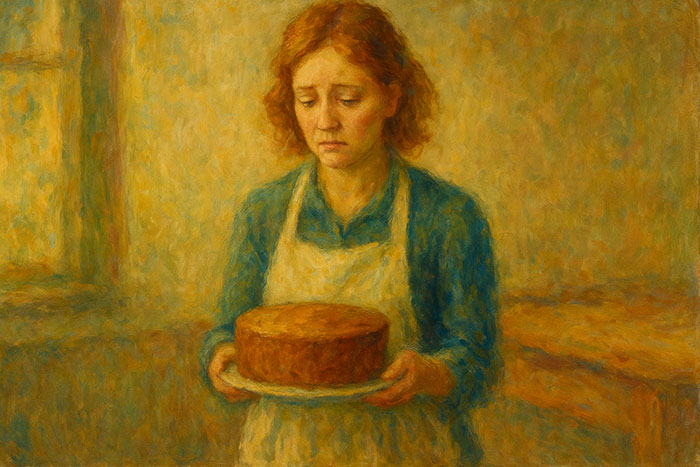
    Soon, the cake was ready. She took it into the café.

    It looked delicious.

    At lunch, the customers tasted the cake.

    “This is not the cake that we usually have. I don’t like it,” said an old man.

    “I can’t eat this,” said a woman.

    “This cake is terrible,” said a boy.

    Paula felt sad. She went into the kitchen and started to cry.

    She didn’t know why the customers didn’t like her cake. She had made it the same way she always did.

    She looked at the kitchen table. The ingredients from the cake were still there. There were apples, eggs, a bottle of milk, a bag of flour, and some butter… But the sugar was not there.

    Then Paula saw the salt. Now, she knew what the problem was. There was salt in the cake, not sugar. Oh no!

    She found some sugar and started to make another cake. When it was ready, she tasted it. This time it was perfect.

    The next day, she told her customers about her mistake.

    “I am so sorry,” she said. “But I have made another cake, and it is perfect. Today there is free cake for everybody.”

    The customers tasted the cake. “This is delicious.” They all said.

    One man said that it was better than usual.

    Paula smiled. Her cake was good, and her customers were happy.

    After she closed the café that night, she cleaned the kitchen. She also put the salt on a high shelf, far away from the sugar.

    📒 Key vocabulary

    • café – a small place to eat and drink
    • far – the opposite of near
    • flour – white powder used to make bread or cake
    • butter – yellow food made from milk
    • oven – a machine you cook food in
    • bake – put something in the oven to cook
    • customers – people who buy things from a shop or restaurant
    • terrible – very bad
    • ingredients – things (food) you use to make a cake or a dish
    • mistake – something you do by accident
    • shelf – a flat piece of material you put objects on

    🤔 Comprehension quiz

    How much of this story did you understand? Test yourself with this easyEnglish quiz!
  • A New Day

    A New Day

    Anna is a young woman. She lives in a small house in a big city. Every morning, Anna wakes up early. She likes coffee. She drinks a cup of coffee and looks out the window. The sun is bright, and the birds sing.

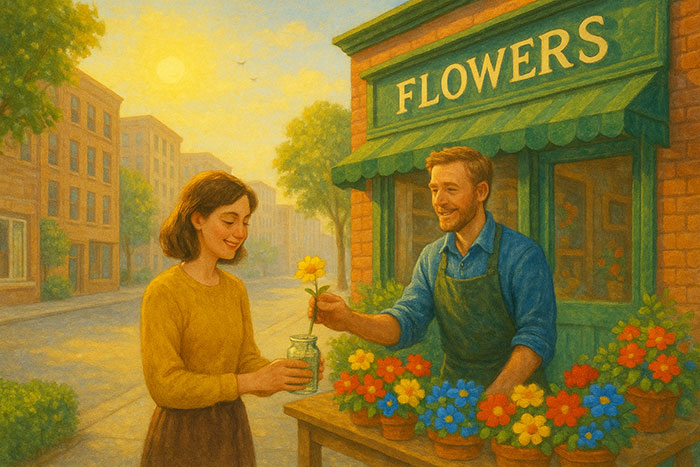
    One day, Anna sees a new shop near her house. It is a flower shop. The flowers are red, yellow, and blue. They are very beautiful. Anna smiles. She loves flowers.

    Anna walks to the shop. A kind man works there. His name is Tom. “Hello,” says Tom. “Do you like flowers?” Anna nods. “Yes, I like flowers. They are nice.”

    Tom gives Anna a small yellow flower. “This is for you,” he says. Anna is happy. She says, “Thank you, Tom!” She takes the flower home.

    At home, Anna puts the flower in a glass with water. She looks at it and smiles. The flower makes her day happy.

    Every week, Anna visits Tom’s shop. She buys flowers, and they talk. Anna and Tom are now friends. Anna’s house is full of colours, and her heart is full of joy.

    📒 Key vocabulary

    young: not old; having a small age

    city: big place with many people and buildings

    morning: early part of the day, after night

    window: hole in the wall with glass to see outside

    sun: bright star in the sky during the day

    birds: small animals with wings that fly

    flower: colourful part of a plant

    beautiful: very nice to look at

    smiles: move your mouth to show happiness

    kind: nice and friendly

    nods: move your head up and down to say yes

    glass: container for drinking, often made of clear material

    happy: feeling good

    week: seven days

    coloursUK/colorsUS: different shades like red, yellow, blue

    joy: strong feeling of happiness

    🤔 Comprehension quiz

    How much of this story did you understand? Test yourself with this easyEnglish quiz!
  • The Lost Passport

    The Lost Passport

    Lina was going to visit her cousin in Spain. It was her first time flying alone. She packed her suitcase, checked her flight, and left early for the airport.

    When she arrived, she went straight to the check-in desk. The airline worker smiled and said, “Passport, please.”

    Lina opened her bag. She looked inside once, then twice. Her passport wasn’t there!

    “I think I lost my passport!” she said, her face red. She started to panic.

    The worker stayed calm. “Where did you last see it?”

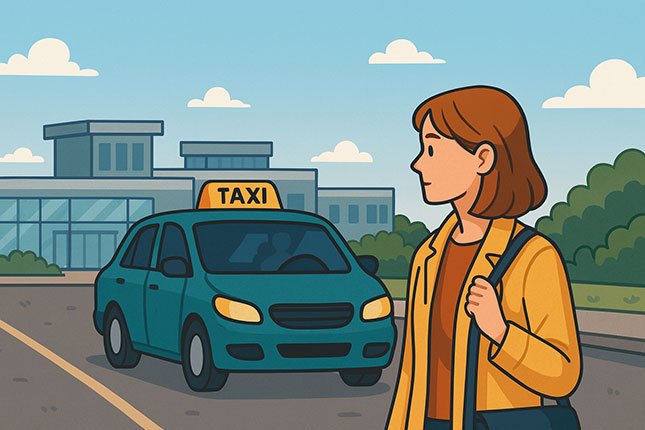
    Lina remembered showing it to a taxi driver by mistake. She called the taxi company. “Please help! I left my passport in the car.”

    Ten minutes later, her phone rang. “We found it!” said the driver. He was already on his way back.

    Lina waited at the entrance. Her hands were shaking. After twenty minutes, she saw the yellow taxi. The driver smiled and gave her the passport.

    “Thank you so much!” she said.

    She ran to the desk again. “You’re just in time,” the worker said. Lina smiled with relief. She had her passport, and now she could fly.

    📒 Key vocabulary

    • passport: official travel document
    • check-in desk: place where travellers show tickets and bags
    • panic: feel sudden fear or worry
    • calm: not nervous or angry
    • entrance: way into a place
    • relief: a good feeling after stress or fear

    🤔 Comprehension quiz

    How much of this story did you understand? Test yourself with this easyEnglish quiz!