
British accent
For years, Ralph and Sarah fantasised about escaping.
At the end of another exhausting week, they would sit at the kitchen table scrolling through photographs of people living off-grid. Wooden cabins beside lakes. Families growing their own food. Children running barefoot through open countryside.
“Imagine not having a mortgage,” Sarah would say.
“Or a boss,” Ralph would add.
What began as a daydream gradually became a plan.
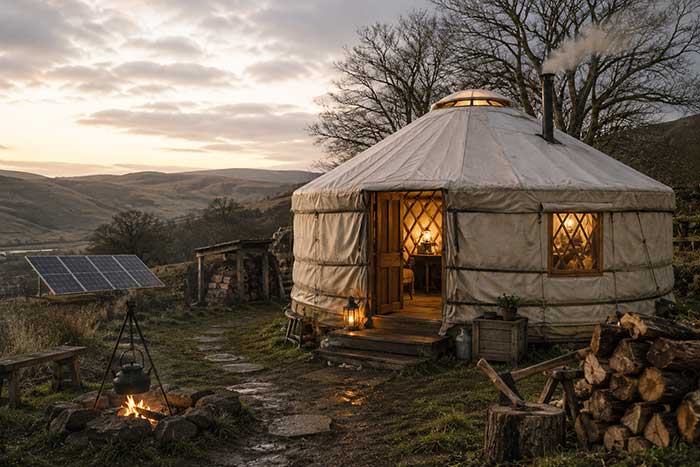
Within eighteen months, they had sold their house, withdrawn their children from school, and bought a small plot of land in rural Wales. Most of their savings went into a large yurt, solar panels and equipment they believed they would need.
At first, the move felt like a triumph.
The rolling hills surrounding their land seemed to promise exactly the freedom they had been searching for. Ben, twelve, and Lucy, nine, spent their days exploring streams and building shelters in the woods, while Ralph and Sarah embraced the challenge of a more self-sufficient lifestyle.
For a brief period, life seemed refreshingly simple.
Then winter arrived.
Living off-grid proved far more demanding than the online videos and glossy blogs had led them to believe. Daily life required planning and effort. Water had to be collected and filtered. Firewood needed chopping and stacking. Even routine tasks consumed far more time than they had anticipated.
The children struggled with the cold. Sarah missed the comfort of a hot shower. Ralph found himself increasingly anxious about money.
Despite their growing doubts, neither wanted to admit that the dream might have been built on unrealistic expectations.
“We just need to get through the first winter,” Ralph kept saying.
But another problem was beginning to emerge.
The nearest neighbour lived almost two miles away.
At first, the isolation had been part of the attraction.
Now, however, it felt less like freedom and more like vulnerability.
One evening, Sarah noticed tyre tracks cutting across their land.
“Did you invite someone?” she asked.
Ralph shook his head.
The tracks disappeared into a wooded area beyond the yurt.
He assumed someone had taken a wrong turn, but when fresh tracks appeared a week later, he became uneasy.
Following them through the trees, he discovered an abandoned caravan concealed among dense undergrowth. Blankets covered the windows, and there was no sign of its occupant.
The discovery left him uneasy.
Over the following weeks, several unsettling incidents occurred.
Food occasionally disappeared from a storage box outside.
A fuel container went missing.
One morning, Ralph found footprints near the yurt. They had been made during the night. Someone had been close enough to touch the canvas walls.
By January, Sarah was struggling to sleep.
Every creak of the yurt made her sit upright. Every gust of wind sounded like movement outside.
One night she woke and realised the dog was growling.
Not barking.
Growling.
Low and steady.
She nudged Ralph awake.
“Listen.”
The dog stood facing the entrance.
Neither spoke.
After several minutes they heard it.
Movement.
Not an animal.
A person.
The sound was unmistakable.
Someone was walking slowly around the outside of the yurt.
Crunch.
Crunch.
Crunch.
The footsteps stopped.
Then came a gentle pull on the door handle.
A surge of fear tightened Sarah’s chest.
The children slept only a few metres away.
Ralph grabbed a heavy torch and shouted.
The footsteps retreated immediately.
Seconds later they heard someone running into the darkness.
Neither of them slept again.
The following morning, Ralph drove straight to the police station.
This time officers searched the area.
What they discovered explained everything.
A man with a history of burglary and violent offences had been living illegally in the abandoned caravan for months. He had chosen the woodland because it was remote and rarely visited.
The family’s arrival had disrupted his solitude.
He had begun stealing supplies and watching them, hoping they would eventually leave.
He was arrested later that day.
What troubled Sarah most was not the incident itself.
It was the realisation of just how exposed they had been.
No neighbours.
No streetlights.
No help within shouting distance.
By spring, they had made a difficult decision.
They moved to a small village several miles away.
The house they rented was modest and far less romantic than the yurt.
Yet on their first evening there, Sarah stood in the kitchen listening to distant voices from neighbouring homes.
For the first time in months, she felt safe.
Later, as they unpacked boxes, Ralph looked at her and smiled.
“Do you regret it?”
Sarah thought for a moment.
“No,” she said.
“The dream wasn’t wrong.”
“What was?”
She glanced through the window at the lights of the village.
“We forgot that independence comes with a price.”
Neither of them ever spoke about living completely off-grid again.
📒 Key vocabulary
- off-grid – living without being connected to public services such as electricity, water or gas supplies
- barefoot – without shoes or socks
- yurt – a large, round tent traditionally used by nomadic people in Central Asia
- shelters – structures or places that provide protection from weather or danger
- filtered (filter, filtered, filtered) – pass through a system that removes dirt or unwanted substances
- stacking – arranging objects in neat piles, one on top of another
- vulnerability – the state of being exposed to possible harm, danger or attack
- uneasy – worried, uncomfortable or slightly afraid
- undergrowth – small plants and bushes growing beneath trees in a forest or wooded area
- unsettling – causing feelings of worry, nervousness or discomfort
- canvas – a strong, heavy cloth used for tents, sails and similar structures
- retreated (retreat, retreated, retreated) – move away from a place, often because of fear or danger
🤔 Comprehension quiz
How much of this story did you understand? Test yourself with this easyEnglish quiz!


Leave a Reply