
American accent
In 2091, the sky turned grey and did not change back. The sun was still there, but a thick cloud covered the planet. After the northern reactors exploded during the war, smoke and dust filled the air. Crops died. Animals disappeared. Cities grew silent. Only small groups of people survived.
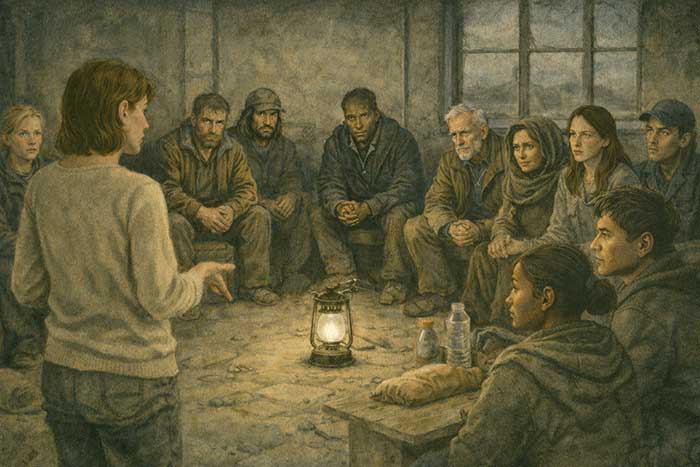
Mara had once been a history teacher. Now she was the leader of twelve people in an underground parking garage beneath a ruined hospital. The concrete walls protected them from the cold wind. Solar panels on the roof gave them a little power when the light was strong enough.
Food was their biggest problem. Every week, two people went to search the empty city. They looked for cans, medicine, tools—anything useful. It was dangerous. Other survivors were not always friendly.
One morning, it was Mara’s turn to go. She left before sunrise with Tomas, a quiet man who had been a nurse. The streets were covered in grey dust. Cars stood where their drivers had left them years before. Windows were broken. Paper moved in the wind like ghosts.
They walked toward the old supermarket district. Mara carried a small radio, a knife, and a backpack. Tomas carried a metal bar for protection. Inside the first store, the shelves were empty. In the second, they found three cans of beans and a bottle of water. Not enough.
“We need more,” Tomas said softly. Mara nodded. They moved deeper into the district. That was when they saw smoke. Not old smoke. New smoke. Someone else was there.
Mara felt her stomach tighten. Another group could mean a fight. Or worse. They followed the smoke carefully and reached a small pharmacy. The door was open. Inside, a fire burned in a metal container. Around it sat five people—thin, tired, and armed.
One of them stood up when he saw Mara and Tomas. “Stop,” he said. Mara raised her hands slowly. “We don’t want trouble. We’re looking for supplies.” The man studied them. His face was hard but not cruel. “We are too,” he said. “There is almost nothing left.”
For a long moment, no one moved. Then Tomas spoke. “There is an underground water tank near the hospital,” he said. “It still works. Clean water.” The man’s eyes changed. Water was more valuable than food.
“And you tell us this why?” he asked. “Because we can’t survive alone,” Mara said. “We are twelve people. You are five. Winter is coming again.” The wind outside howled through the broken windows.
The man looked at his group. A young girl sat near the fire, wrapped in a blanket. An older woman coughed quietly. Finally, he lowered his weapon. “My name is Erik,” he said.
That afternoon, fifteen people walked back to the hospital garage together. It was not easy at first. They did not trust each other. They counted food carefully. They argued about space and rules.
But they also worked. Erik knew how to repair engines. He fixed an old generator in the basement. The older woman knew about plants. She showed them how to grow mushrooms in the dark. The young girl read books aloud at night, her voice soft but calm.
Weeks passed. The sky was still grey. The world was still broken. But under the hospital, there was light. There was clean water. There were small green plants growing in boxes.
One evening, Mara stood near the entrance and listened to the quiet sounds of people talking, cooking, and living. They were not just hiding. They were building something. They were the survivors. And together, they were stronger than the end of the world.
📒 Key vocabulary
- reactors – large machines that produce energy
- crops – plants grown for food
- concrete – very hard building material
- solar panels – devices that use sunlight to make electricity
- district – an area of a town or city
- armed – carrying weapons
- supplies – things that are needed (food, tools, medicine)
- water tank – a container for collecting or storing water
- howled (howl, howled, howled) – make a loud, aggressive sound
- wrapped (wrap, wrapped, wrapped) – envelop or cover with
- generator – a machine that makes electricity
- basement – room below a building
🤔 Comprehension quiz
How much of this story did you understand? Test yourself with this easyEnglish quiz!
Leave a Reply