
American accent
Ted had always prided himself on being a cautious driver. He respected speed limits, avoided distractions, and treated the road with quiet seriousness. Driving, to him, was a responsibility—not a risk.
That belief shattered on a cold, lightless night.
The road had been nearly empty, the kind of road one drives without thinking. Then, without warning, a figure burst out of the darkness. A teenage boy—unsteady, stumbling—ran directly into the path of Ted’s car. There was no time to react. Ted slammed the brakes, but the impact came instantly, violently, with a sound he would never forget.
The police later confirmed what witnesses had said: the boy had been heavily intoxicated. He had not looked before crossing. Ted had not been speeding. Legally, he bore no responsibility.
But the law offered no comfort.
In the months that followed, Ted’s life began to unravel in quiet, persistent ways. Sleep abandoned him first. When he did manage to rest, his dreams returned him to that moment—the flash of headlights, the helpless certainty, the sound. Always the sound.
Daylight brought no relief. At work, he found himself unable to concentrate. Numbers blurred. Conversations slipped past him unnoticed. His once reliable performance declined, and colleagues began to exchange concerned glances.
Outside the office, his world shrank. He avoided driving whenever possible, inventing excuses or enduring long, exhausting walks. When he did sit behind the wheel, his body tensed, his breath shallow, his eyes searching every shadow for movement.
But the worst part was the silence.
Ted spoke to no one about the accident. Not to his colleagues, not to his friends, not even to his sister, Anna. The guilt settled inside him like a weight – unseen, but constant.
It was Anna who finally broke through.
One evening, she arrived unannounced and found him sitting in the dim glow of a lamp, untouched food on the table beside him.
“This isn’t just grief,” she said gently after a long silence. “It’s something heavier.”
Ted let out a hollow laugh. “I ended someone’s life, Anna. What could be heavier than that?”
“You didn’t choose it,” she replied. “But you’re choosing what happens next.”
Her words lingered, unsettling and impossible to ignore.
A few days later, Ted did something he had resisted for months: he sought help. He joined a support group for people affected by fatal road accidents. The first meeting was uncomfortable, almost unbearable. Yet as he listened, he realised he was not alone in his confusion or his guilt.
When he finally spoke, his voice was quiet but steady. “Everyone says it wasn’t my fault,” he admitted. “But that doesn’t change what I did.”
An older man across the circle leaned forward. “No,” he said softly. “But it can change what you do with it.”
That idea stayed with Ted.
Weeks passed, and something began to shift. Not dramatically, not all at once—but enough. Ted started to understand that guilt, left unchecked, could become a kind of self-punishment that served no one. Least of all the boy whose life had ended.
One evening, after a particularly difficult session, the group leader approached him.
“There’s something you might consider,” she said. “The boy’s parents have been open to meeting, when both sides feel ready.”
Ted felt his chest tighten. The idea terrified him. Yet, beneath the fear, there was something else—a quiet sense that he could not move forward without it.
A month later, he agreed.
The meeting took place in a small community centre. Ted arrived early, his hands cold despite the warmth of the room. When the boy’s parents entered, he stood instinctively, unsure of what to say or where to look.
The boy’s mother spoke first. “Ted?”
He nodded.
For a moment, no one moved. Then, unexpectedly, she stepped forward and embraced him. Ted froze, overwhelmed.
“We know what happened,” she said quietly. “We’ve read everything. You didn’t do anything wrong.”
Ted’s voice trembled. “But he’s gone.”
“Yes,” the father said, his tone steady but heavy with grief. “And nothing will change that. But blaming yourself forever won’t change it either.”
They spoke for a long time—about the boy, about that night, about the terrible weight each of them had been carrying. There were tears, long silences, and moments when words simply failed. Yet something shifted between them: not a simple forgiveness, but a shared understanding of a tragedy no one had intended.
Before they left, the mother pressed a small photograph into Ted’s hand.
“This is how we remember him,” she said. “Not the way he died.”
Ted looked at the image—a smiling teenager, alive and full of careless joy. For the first time, the memory of that night became slightly less intense.
A few days later, Ted did something he had avoided for months.
He drove.
The night felt familiar—the same dim streetlights, the same quiet road. His hands tightened on the steering wheel as he approached the place where everything had changed. His breath slowed, his chest heavy with anticipation.
For a moment, he considered turning back.
Instead, he pulled over.
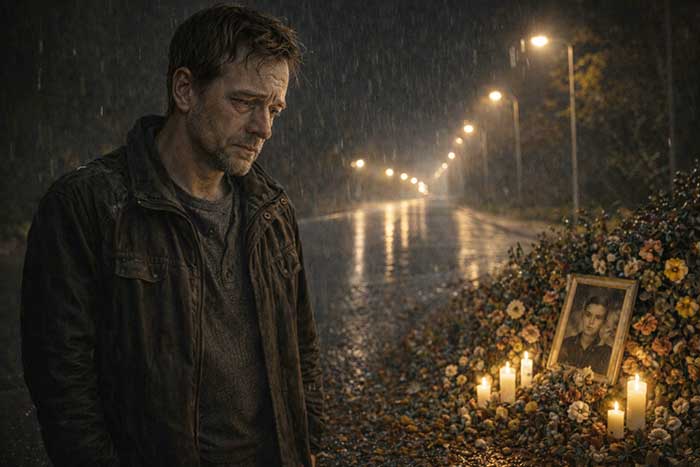
The road looked ordinary now, untouched by memory except for what he carried within him. Ted stepped out of the car and stood in the stillness. He took the photograph from his pocket and looked at it once more.
“I’m sorry,” he said softly. “And I won’t forget.”
The words did not erase the past. They did not lessen the loss. But they no longer felt like a punishment—only a promise.
After a moment, Ted returned to the car.
This time, when he started the engine, his hands did not shake.
The road ahead remained dark, uncertain, and real. But for the first time, Ted did not feel trapped by it.
He drove forward.
📒 Key vocabulary
- prided (pride, prided, prided) – feel very satisfied or proud about something
- shattered (shatter, shattered, shattered) – suddenly break or destroy
- stumbling – walking in an unsteady way
- slammed (slam, slammed, slammed) – hit or move something with force
- bore (bear, bore, borne) – carry or accept responsibility
- unravel – gradually fall apart or become worse
- blurred (blur, blurred, blurred) – become unclear or difficult to see
- shrank (shrink, shrank, shrunk) – become smaller or reduced
- tensed (tense, tensed, tensed) – become tight due to stress or fear
- glow – a soft, steady light
- hollow – empty or lacking feeling
- lingered (linger, lingered, lingered) – stay for longer than expected
- unsettling – making someone feel nervous or uncomfortable
- sought (seek, sought, sought) – tried to find or get help
- unchecked – not controlled or limited
- trembled (tremble, trembled, trembled) – shake slightly, usually from fear or emotion
- blaming – saying someone is responsible for something bad
- shifted (shift, shifted, shifted) – change slightly
- pulled over (pull over, pulled over, pulled over) – stop a vehicle at the side of the road
- stillness – complete quiet and lack of movement
🤔 Comprehension quiz
How much of this story did you understand? Test yourself with this easyEnglish quiz!
Leave a Reply