
Advertisement

Home » B1 » Page 3

Level: B1

  • The Waiter

    The Waiter

    Roger was a waiter in a trendy French restaurant. Every day he carried heavy plates, delivered drinks, and carefully took orders from the tables. He greeted every customer politely and smiled, even when he was exhausted. But many customers did not treat him the same way. Some snapped their fingers to grab his attention, others shouted across the room, and a few made silly jokes about the food. Roger never shouted back. On the outside he appeared calm, but inside he was angry. He worked hard every day, yet nobody seemed to respect him.

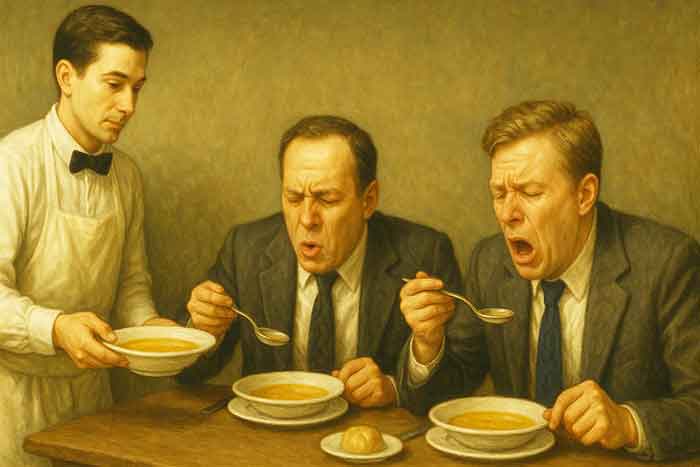
    One evening the restaurant was full. Every table was taken, and the noise of voices filled the room. Roger was serving a group of businessmen. From the beginning, they were difficult. First, they complained that the soup was ‘too cold’. They sent it back to the kitchen, then sent it back again a second time, claiming it was still not hot enough.

    Roger’s patience was running out. The third time, he made it so hot that steam filled the air. When the men tasted it, they burnt their tongues. They shouted and waved their hands, but Roger only smiled politely. Inside, he felt a secret joy.

    Later, one man asked for more pepper on his steak. Roger took the steak back to the kitchen and put so much pepper on it that the meat was barely visible. Then, when the man tried to eat his peppery steak, he couldn’t stop sneezing.

    Soon after that, another man shouted for water. Roger brought him a glass filled right to the top. The moment the man touched it, water spilt over the table and onto his expensive suit. Roger smiled politely and said, ‘So sorry, sir,’ while the man tried to dry his clothes.

    The businessmen were already upset, but Roger was not finished. When they asked for bread, he brought the hardest bread from the basket. It was old and dry, and when they tried to break it, small crumbs flew across the table and onto their clothes. The other diners turned their heads, trying not to laugh as the men fought with the bread.

    Next, the businessmen ordered an expensive bottle of wine. Roger went to the kitchen, but he did not bring wine. Instead, he brought a wine bottle filled with grape juice. He poured it slowly into their glasses. The men sipped and nodded with serious faces. ‘Excellent wine,’ one of them said proudly. Roger kept his face serious too, but inside he was almost laughing out loud.

    At last, the meal was finished. Roger carried the bill to the table. Inside the folder was not only the bill but also a small note, written in neat handwriting:

    ‘I hope you enjoyed your meal. I made a few changes to your meal tonight. Some of these changes may have escaped your notice. Be careful how you treat your waiter. Next time, the changes will be more obvious.’

    The businessmen stared at the note with confused faces. When they looked up, Roger was no longer there. His apron lay folded on the counter, and nobody had seen him leave.

    📒 Key vocabulary

    • trendy – fashionable or popular at the moment
    • snap (snap, snapped, snapped) – make a quick, sharp sound or movement, often with fingers, to get attention
    • steam – the hot gas that comes from boiling water
    • sneezing – suddenly blowing air through the nose and mouth, often because of dust or pepper
    • spill (spill, spilled, spilt)– cause liquid to flow out by accident
    • crumbs – very small pieces of bread, cake, or other food
    • diners – people eating in a restaurant or café
    • sip (sip, sipped, sipped) – drink slowly in small amounts
    • nod (nod, nodded, nodded) – move head up and down to show agreement
    • folder – a cover or container used to hold papers
    • handwriting – writing done by hand, not printed by a machine
    • apron – a piece of clothing worn over the front of the body to protect clothes, usually while cooking or serving

    🤔 Comprehension quiz

    How much of this story did you understand? Test yourself with this easyEnglish quiz!
  • The Donor

    The Donor

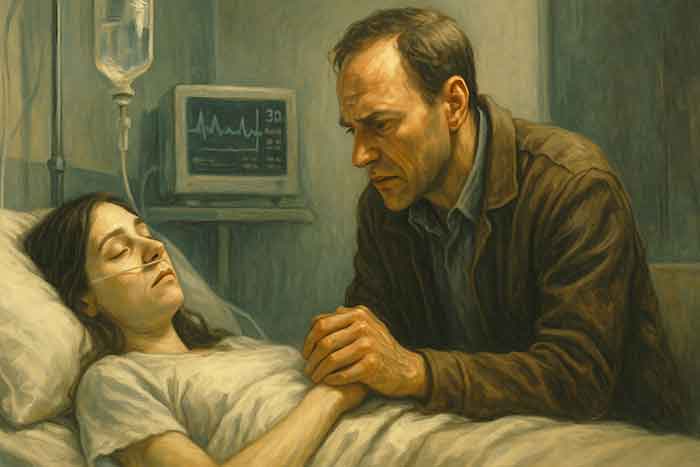
    Henry sat in the hospital waiting room, holding his head in his hands. The place had started to feel like a second home since his wife Claire had become so sick. Both her kidneys had now stopped working. Doctors said she had only weeks left to live.

    Claire needed a new kidney, and she was running out of time.

    Family and friends had all been tested, but no one was a match. Henry thought he was going to lose her.

    As a last resort, Henry decided to post his wife’s story on social media in the hope that a donor would come forward. Days passed, but nothing happened.

    Then, just as he was losing hope, a stranger got in touch who offered to donate one of his kidneys. His name was Victor, and his kidney was a perfect match.

    For the first time in months, Henry felt hopeful. Delighted, he ran into Claire’s room and told her she would live.

    The operation was planned. Henry bought flowers. He even smiled again. But on the morning of the surgery, the doctor walked into the room, his face pale.

    “Victor has changed his mind,” he said.

    Henry stared at him. “What do you mean?”

    “He won’t do it. He says it’s too dangerous for him.”

    Henry’s world broke. He was furious. Claire lay in the next room, fighting for her life, while the one man who could save her turned away.

    That night, Henry drove to Victor’s house. He sat in the car, watching the lights inside. Through the window, Victor ate dinner with his wife and little daughter. They laughed together.

    Watching the joyful family scene made Henry even angrier. Claire should be here too, he thought. We should be eating dinner, not waiting for death.

    He knocked on the door.

    Victor opened it, surprised. “Henry? What are you doing here?”

    “You promised,” Henry whispered. “She’s dying.”

    Victor shook his head. “I can’t. I have a family. I can’t risk my life.”

    Henry’s eyes went to the heavy candlestick on the table inside. His hand moved toward it.

    “Please,” he said, his voice shaking.

    Victor didn’t answer. He only pulled the door closer to shut it.

    Henry lost control. His hand grabbed the candlestick. He swung. Once. Twice. Victor fell to the ground with a thud. Blood spread on the carpet.

    Henry froze, breathing hard. His ears rang. Then he heard small footsteps.

    Victor’s daughter stood in the hallway, holding a toy bear, staring at him.

    “Daddy?” she whispered.

    Henry’s stomach twisted. But it was too late to stop now. He stepped past the girl and dragged Victor’s body toward the car.

    The next morning, Henry sat by Claire’s bed, his clothes clean, his face calm. The doctors entered with serious but hopeful expressions.

    “We’ve had some luck,” one said. “A kidney has just become available. We can do the transplant today.”

    Henry kissed Claire’s hand, his eyes wet with false relief.

    “That’s wonderful,” he said softly.

    Claire smiled weakly. “See? I told you not to give up.”

    Henry forced a smile. He could not tell her the truth. She would never know the price he had paid.

    But as the nurses prepared Claire for surgery, Henry’s heart pounded with a new fear: not of losing her, but of living with what he had done.

    📒 Key vocabulary

    • kidneys – organs in the body that clean the blood and make urine
    • donor – a person who gives something, especially an organ, blood, or money
    • donate – give something to another person
    • surgery – a medical treatment where doctors cut into the body to repair or remove something
    • pale – white, without colour
    • candlestick – a holder for a candle
    • thud –  a heavy, dull sound made when something falls or hits
    • dragged – pulled with effort
    • transplant – a medical operation where an organ is taken from one person and put into another
    • pound – hit something again and again, or beat strongly (like a fast heartbeat)

    🤔 Comprehension quiz

    How much of this story did you understand? Test yourself with this easyEnglish quiz!
  • Wealth

    Wealth

    From the outside, Jim’s life looked perfect. He had everything most people dreamed of. He was successful at work; he lived in a big house and had a garage full of sports cars.

    He and his beautiful wife had a busy and exciting social life. They enjoyed expensive holidays with friends and loved entertaining guests.

    But inside, Jim felt empty. He told himself that money and success should be enough. Still, he had the feeling that something was missing from his life.

    Slowly, Jim’s life began to fall apart. At work, the company was losing money. His boss no longer trusted him. Each month, the pressure increased. Finally, one morning, Jim was called into a meeting where he was dismissed from his job. He was devastated.

    With no money coming in, Jim could no longer afford to maintain his expensive lifestyle. His friends and invitations to parties disappeared. He felt very alone.

    At home, things were no better. Without a busy social life, Jim and his wife began to drift apart. When they were at home together, they hardly spoke. One day she packed her bags and told Jim she was leaving him for someone else. He never saw her again.

    Without his job, Jim could not pay for the house or the cars. One by one, they were sold. The big house stood empty. Finally, he had to leave. The man who once had everything now had nothing.

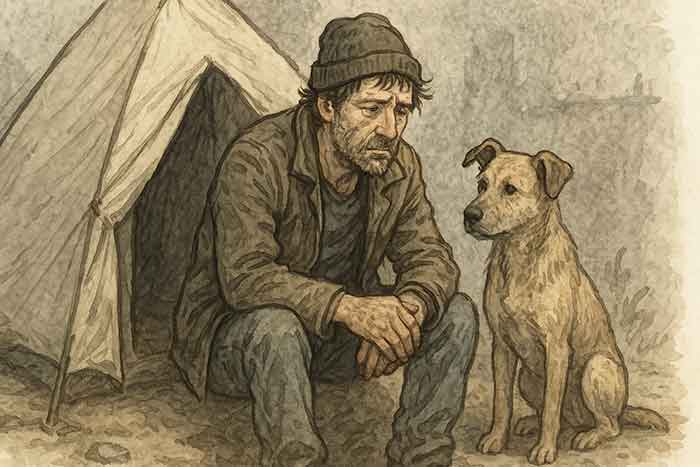
    Unable to pay for a hotel room, Jim found himself living in a small tent at the edge of the city. Nights were cold, and food was hard to find. He searched in bins behind shops and restaurants. Sometimes he ate old bread, sometimes nothing at all. The man who had once worn clean suits now wore the same old jacket every day. His wallet was empty, and his stomach was too.

    One evening, a stray dog came near Jim’s tent. Its fur was dirty and its body thin. But in its mouth was a piece of food. The dog dropped it in front of Jim. At first Jim wanted to push it away, but hunger was stronger. He ate and then shared what was left with the dog. The animal licked his hand. For the first time in weeks, Jim smiled.

    The next day the dog returned. Sometimes it brought pieces of food, sometimes only its company. Jim began to talk to it. The dog listened, as if it understood. Slowly, they became friends.

    Weeks passed. Jim and the dog were always together. They looked for food during the day and slept close to each other at night. The dog gave Jim comfort, and Jim gave the dog care. Their lives were hard, but they were not alone.

    One evening, Jim sat outside his tent, the dog’s head resting comfortably on his leg. He thought about the wealth he had once had and how it had left him feeling empty. Now, with nothing but a loyal friend by his side, he felt richer than he had ever felt before.

    📒 Key vocabulary

    • successful – doing well in work or life
    • empty – without meaning, not full
    • missing – absent
    • boss – the person who leads at work
    • dismissed – sacked; removed from a job
    • devastated – extremely upset
    • drift apart – become more distant
    • tent – small cloth shelter used for camping
    • bins – garbage cans
    • stray – without a home (used for animals)
    • fur – the soft hair covering certain animals
    • wealth money and possessions
    • loyal – faithful and reliable

    🤔 Comprehension quiz

    How much of this story did you understand? Test yourself with this easyEnglish quiz!
  • Ten of Hearts

    Ten of Hearts

    It was nearly midnight. Tim sat at his kitchen table, holding his head in his hands. In front of him was a pile of unpaid bills that seemed to be growing by the day. His hands were cold, and his head hurt from weeks of worry.

    Every letter he opened seemed to be worse than the last. He had never felt so desperate.

    “There’s no way out,” he said to himself.

    Suddenly, there was a knock at the door. Wondering who could be visiting so late on a Monday night, Tim opened the door cautiously. A tall man in a dark coat stood there.

    His face was calm, but his eyes were sharp.

    “Good evening, Tim,” the man said. “I know about your problems, and I can help you. Please let me explain.”

    The man walked into the kitchen and put a deck of cards on the table. The cards looked old.

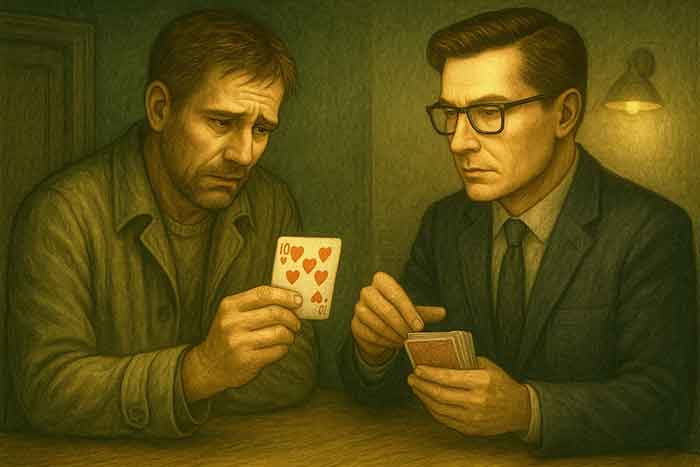
    “All your debts can disappear tonight,” the man said. “All you need to do is pick one card.”

    Tim looked at the deck. “This sounds like a trick.”

    “Not a trick,” the man said. “But there is a risk. If you pick the ten of hearts, something terrible will happen. Not to you, but to someone you know.”

    Tim felt sick. He thought of his sister. He thought of his best friend, Mark.

    But he felt he had no choice. Besides, what were the chances of him picking the ten of hearts when there were 51 other cards in the deck?

    The man pushed the deck closer. “Pick, Tim.”

    Nervously, Tim picked a card. When he turned it over, he froze.

    The ten of hearts.

    Tim dropped the card on the table. His body felt cold. “No…”

    The man’s smile grew wide. “A bold choice, Tim. But I’m afraid that fate can be cruel.”

    At that moment, Tim’s phone rang. His sister’s name appeared on the screen. He answered with shaking hands.

    Her voice was full of fear. “Tim… Mark’s been in an accident. He is in the hospital. They don’t know if he will live.”

    Tim dropped the phone. The man picked up the ten of hearts, put the deck into his coat, and stood.

    “Your debts are gone,” he said. “But freedom always has a price.”

    The door closed behind him, leaving Tim alone in silence. The bills were gone from the table, but the cost was already too high.

    📒 Key vocabulary

    • bills – pieces of paper that show money you must pay
    • debts – money you must pay back
    • cautiously – in a careful or nervous way
    • deck – a full set of playing cards
    • risk – the chance that something bad may happen
    • bold – not afraid, showing courage
    • fate – what happens in life that you cannot control
    • cruel – very unkind, causing pain

    🤔 Comprehension quiz

    How much of this story did you understand? Test yourself with this easyEnglish quiz!
  • Mrs. Wood

    Mrs. Wood

    Clara sat by the window, yawning and drinking tea. She was seven months pregnant, and the baby growing inside her was making her very tired.

    Clara should have felt excited, but instead she was lonely. She and her husband had just moved to North Street, leaving behind her old job and her friends. The new house was pleasant enough, but the street was quiet, and the neighbours never spoke to her.

    Her husband, Matt, worked long hours at the hospital. This meant that most evenings, Clara ate dinner alone, listening to the clock tick slowly. The silence made the house feel even bigger than it was.

    Without anyone to talk to or a job to go to, the days passed slowly. As a result, Clara had started taking naps in the middle of the day.

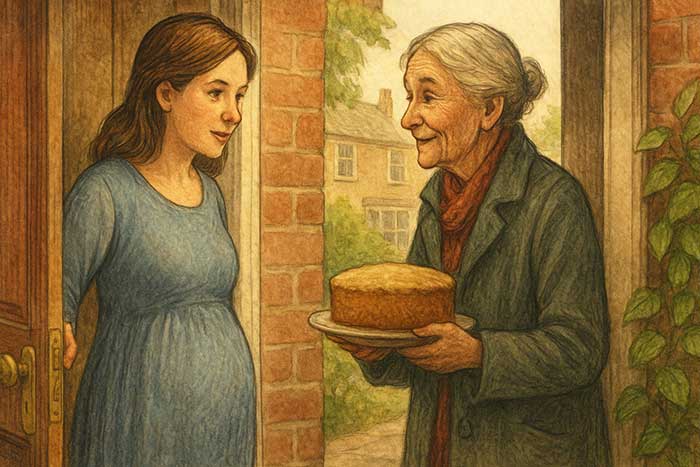
    One afternoon, there was a knock at the door. When she opened it, an old woman stood there smiling. She was wearing a red scarf and holding a small cake.

    “Hello, dear. I’m Mrs. Wood. “I live two doors down, at number 23,” the woman said. “I thought you might like this.”

    Clara was surprised but grateful. “Oh, thank you! That looks delicious. Please, come in, and I’ll make us some tea.”

    They sat in the living room and chatted over tea and cake. Clara learned that Mrs. Wood was a widow and that her only son, Andrew, lived in another city. She also learned that Mrs. Wood had a passion for baking and made a different cake every day. They were so busy talking that the time flew by, and before they knew it, it was starting to get dark.

    ‘‘Goodness, look at the time,’’ said Mrs. Wood. I must be getting back. ‘‘My son visits every Tuesday, and if I don’t answer the door, he gets worried.’’

    “Please come again,” said Clara. ‘‘It has been so nice to have some company. Today is the first time in weeks that I have spoken to anyone except my husband.’’

    From that day on, Mrs. Wood came almost every afternoon. She always brought a small cake—chocolate, lemon, or fruit. They would sit, talk, and laugh. Clara told her about her life, and Mrs. Wood shared stories about her own childhood. For the first time since moving to North Street, Clara felt she had a friend.

    One Tuesday afternoon, after Mrs. Wood had left, Clara noticed a red scarf on the sofa. It must have slipped from the old lady’s shoulders as she was getting up to leave.

    She put on her coat and walked down the road to number 23, scarf in hand.

    As she reached the gate, she saw someone leaving the house. It was a young man, carrying some letters. Clara guessed he must be Mrs. Wood’s son. Relieved, she held out the scarf.

    “Hello! You must be Andrew.’’

    ‘Um, yes. “I am,” he said, with a puzzled look on his face. ’How do you know my name?’’

    “I am a friend of your mother’s,” Clara continued.

    The man frowned. “My mother?”

    “Yes, Mrs. Wood. She lives here, doesn’t she? We’ve become friends, and she visits me every afternoon.” Clara smiled nervously.

    The man’s face grew pale. He shook his head. “No… I think you must be mistaken; Mrs. Wood was my mother, but she died last year. Nobody lives here now. I’ve just come to collect the mail.”

    Clara froze, staring at the scarf in her hand. It was still warm, as if someone had just been wearing it.

    📒 Key vocabulary

    • yawning – stretching the mouth open because of fatigue
    • pregnant – when a woman is going to have a baby
    • lonely – feeling alone and sad
    • knock – the sound of someone hitting the door to enter
    • widow – a woman whose husband has died
    • grateful – feeling thankful
    • gate – a door in a fence or wall outside a house
    • frown – to make a serious or worried face
    • pale – light in color, often because of shock or fear
    • frozen – unable to move, often because of fear

    🤔 Comprehension quiz

    How much of this story did you understand? Test yourself with this easyEnglish quiz!
  • A Voice in the Dark

    A Voice in the Dark

    It was a wet October evening. The wind howled outside the old library as Nancy locked the heavy front door. She was the only staff member working late that night. The library was always different after dark. The bookshelves looked taller, the lights seemed to flicker, and the place always felt much cooler.

    Nancy told herself she was not afraid, but the silence made her nervous. She spent the next fifteen minutes tidying and turning off the computers, then, just as she was about to put her coat on and go home, she heard a voice. It came from the far end of the reading room.

    “Hello?” she said, her voice shaking.

    But there was no answer.

    She walked slowly toward the sound. Her shoes made quiet taps on the wooden floor. The voice came again. This time, it was clearer. It sounded soft but urgent:

    “Help me.”

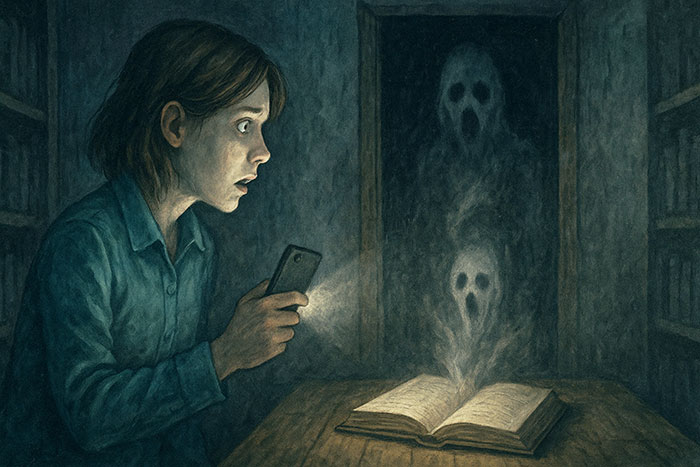
    Nancy stopped. She knew the library was empty, as she had seen the last person leave over an hour before. Puzzled, she took her phone out of her pocket and turned on the torch. As the beam of light moved across the back wall, revealing a narrow line half hidden by one of the shelves. After removing some heavy books, Nancy was able to push the shelf aside. It was then that she realised the line was part of a door.

    Nancy’s heart beat fast as she reached for the door handle. The door creaked open. Inside was a small, dark room. It smelt of old paper and damp wood.

    In the room, she saw a single wooden chair and an old book on the floor. Even though the air was still, the pages moved slowly.

    “Help me,” the voice whispered again. This time, it came from the book.

    Nancy moved closer. The letters on the page moved. She could read them clearly: I am trapped. Take my place.

    Cold fear ran through her body. She wanted to run, but she could not move.

    Suddenly, cold hands grabbed her shoulders. She tried to scream—but no sound came out. The pages turned faster. A dark shadow rose from the book and pulled her toward the pages.

    Her vision blurred. The room turned. The last thing she saw was the open page—with a picture of herself inside the book, looking out.


    Early the next morning, a new librarian arrived. As usual, the place was quiet, yet something felt different. Suddenly, she noticed that one of the bookshelves was out of place. As she made her way towards it, she saw the open door. Curious and excited, she put down her books and went inside.

     On the floor lay a phone with its torch still shining. Next to it was an old book.

     It was not a book she recognised.  … And it seemed to be crying out for help.

    📒 Key vocabulary

    • howled – made a loud, long sound, like wind or an animal
    • flickered – shone with an unsteady or moving light
    • faint – very quiet or weak
    • torch – flashlight
    • damp – slightly wet
    • trapped – unable to escape
    • shadow – a dark shape made when light is blocked
    • blurred – not clear or hard to see

    🤔 Comprehension quiz

    How much of this story did you understand? Test yourself with this easyEnglish quiz!
  • A Memorable Voyage

    A Memorable Voyage

    It was supposed to be a simple holiday. Alex and Mia, two university friends, had booked a sailing trip around the coast of Croatia. The plan was clear: sun, sea, and plenty of relaxation. And that’s exactly what it was, at least to start with. But on the third day, everything changed.

    The morning had started peacefully. The sea was calm, and the boat moved gently through the blue water. Captain Leo, an experienced sailor, chatted with them while pointing out small islands and hidden beaches. Mia used the opportunity to take photos with her new camera while Alex relaxed in his seat, enjoying the warmth of the sun on his skin. Around noon, however, dark clouds suddenly appeared on the horizon.

    “It’s just a passing storm,” Leo said. “Nothing to worry about.”

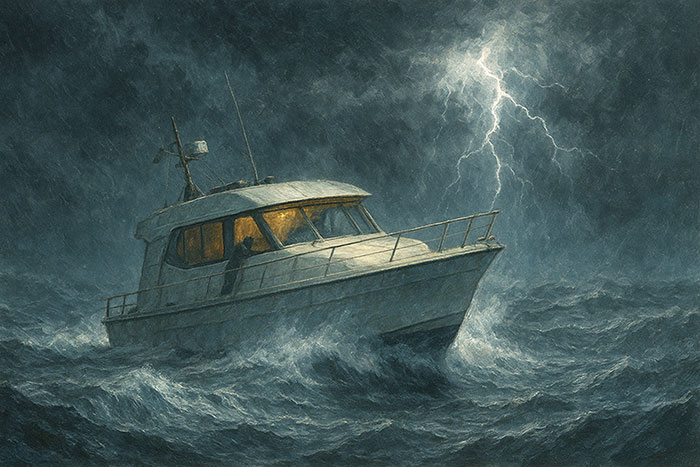
    But within an hour, the wind picked up, and the waves grew larger. Rain fell hard, and the boat rocked from side to side. Leo tried to steer toward a nearby island, but visibility was poor. Suddenly, there was a loud bang. The boat had hit a rock under the water.

    “We’re taking on water!” Leo shouted.

    Alex grabbed the emergency radio to call for help, while Mia helped Leo check the damage. The engine was dead, and the lower deck was flooding. The storm was getting worse. They had minutes to get off the boat.

    They jumped into the lifeboat as lightning split the sky. Waves lifted and dropped them back heavily onto the water. Then—a giant wave hit them sideways, throwing Mia into the sea.

    “MIA!” Alex screamed.

    She surfaced a few seconds later, coughing, but another wave was coming. Without thinking, Alex dived in. Leo shouted behind them, but it was too late. Alex was already in the water, holding on to Mia.

    Together, the pair swam towards the island with all their strength. They reached the rocky shore, bruised and breathless, just as the wrecked lifeboat washed up beside them. Their hands were bleeding from the sharp rocks, but they were alive.

    The beach was narrow, with steep cliffs behind it. There was no way up.

    “We have to signal somehow,” Mia gasped.

    Alex grabbed a piece of the broken lifeboat and set it on fire with Leo’s lighter. Black smoke rose quickly into the air.

    For hours, they waited, hiding from the cold behind a rock wall. Then, just before sunset, the sound of a helicopter cut through the wind. A search light lit up the beach—and stopped on them.

    They jumped up, waving their arms in the air.

    As the rescue team lowered a rope, Alex looked back at the dark sea and the broken lifeboat. What began as a peaceful trip had turned into a frightening battle for survival.

    📒 Key vocabulary

    • horizon – the line where the earth or sea seems to meet the sky
    • visibility – how far you can see, especially in bad weather
    • lifeboat – a small boat used in emergencies
    • surface (v) – to come up to the surface of the water
    • bruised – having dark marks on the skin from being hit
    • signal (v) – to send a message using actions or signs
    • searchlight – a strong light used to find things in the dark

    🤔 Comprehension quiz

    How much of this story did you understand? Test yourself with this easyEnglish quiz!
  • The Locked Door

    The Locked Door

    It was a dark and stormy night when Mark arrived at the house. Rain hit the windows like small stones, and the wind made the trees outside shake and groan. Mark had never been to this house before. His uncle had died the month before and left it to him in his will. Mark didn’t know much about his uncle, only that he lived alone and rarely spoke to anyone.

    The house stood alone in the countryside, far from the village. Mark parked his car and quickly ran to the door. He used the key and opened it. The door creaked loudly. Inside, it was cold, dark, and quiet. Dust covered the furniture, and cobwebs filled the corners. Strange paintings of people with blank faces were on the walls. The air smelt of old paper and wet wood.

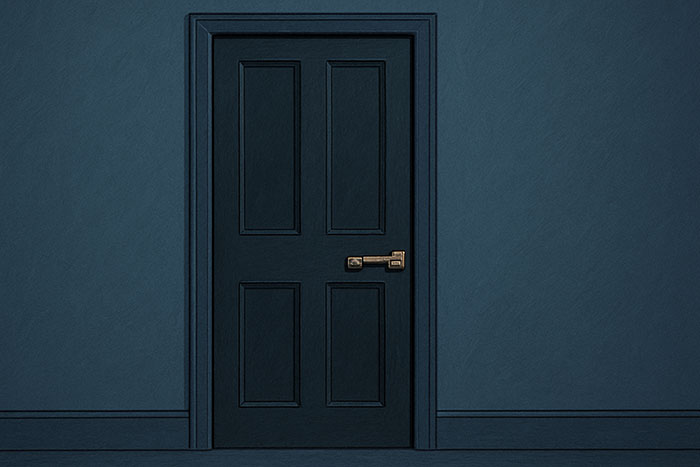
    Upstairs, Mark found three bedrooms and a small study. But one door at the end of the hallway caught his attention. It was black and had a heavy lock. He tried all the keys, but none worked. He leaned closer.

    Thump.

    Something moved inside. Or was it just his imagination?

    That night, Mark couldn’t sleep. The wind howled, and strange sounds came from upstairs—soft scratching, whispers, and quiet knocks. He tried to stay calm and told himself it was only the old house making noises. But he didn’t believe it.

    The next day, he went to the village and asked an old woman at the small shop about the house.

    “The locked room?” she said with a frown. “Your uncle warned everyone never to open that door. He believed something evil lived in that room.”

    Mark laughed nervously. “Do you mean a ghost?”

    But the woman didn’t smile. “Worse than a ghost.”

    That night, the noises came back—louder and faster. Mark couldn’t take it anymore. He grabbed a torch and an umbrella for self-defence. Just after midnight, he went upstairs. His heart was beating fast. The black door was shaking as though something was trying to get out.

    He forced it open. The room inside was freezing cold. A single chair stood in the centre, facing the wall. On it sat a tape recorder. Mark stepped inside and pressed play.

    His uncle’s voice spoke: “If you hear this, it means I’ve failed. It’s awake. Do not stay. Leave the house now.”

    Suddenly, the door slammed shut behind him. Mark turned around. In the shadows, something moved. Something with glowing red eyes.

     And then—the lights went out.

    📒 Key vocabulary

    • groan – make a sound of deep unhappiness
    • will – a legal document that says what is to happen to somebody’s money and property after they die
    • warned – to have told someone about a possible danger or problem in order to prevent harm
    • slammed (shut) – closed loudly with force
    • glowing – shining brightly

    🤔 Comprehension quiz

    How much of this story did you understand? Test yourself with this easyEnglish quiz!
  • The Mirror in the Attic

    The Mirror in the Attic

    Lena was tired of city life and her boring office job. So, when her cousin asked her to look after his pets for a year in his cottage in the countryside, she accepted his offer right away. She gave up her room in the flat she shared in London, packed her things, and took the train north to the quiet village of Stonely.

    Lena soon settled into village life and enjoyed the company of the cats. But the silence of the cottage house was too quiet—unnaturally quiet. The wind whispered through cracks in the wooden walls, and at night the floorboards seemed to groan under invisible footsteps. She wanted peace, but now she wasn’t sure if she was truly alone.

    One evening, Lena decided to go up and check. She climbed the wooden stairs slowly. Each step made a loud creak. When she opened the attic door, the cold air hit her face. The room was dark and full of old furniture and boxes.

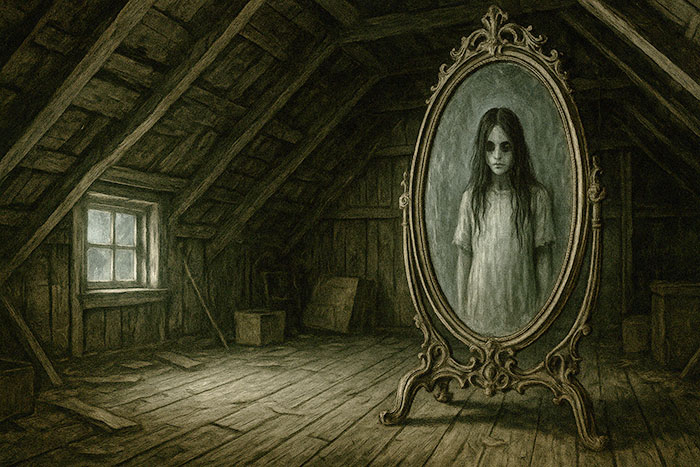
    In the corner, she saw a large mirror. It was tall, with a black wooden frame. The glass was dirty, but she could still see her reflection. As she looked into it, something felt strange. Her reflection didn’t move the same way she did. When she raised her right hand, the reflection raised its left.

    Lena stepped back, confused.

    “That’s not possible,” she whispered.

    She turned off the light and left the attic, trying to forget about the mirror. But that night, she couldn’t sleep. She felt like someone was watching her.

    The next day, she returned to the attic. The mirror was still there. This time, she cleaned the glass to see better. As she wiped it, the reflection smiled — but Lena didn’t. She froze. The reflection moved on its own.

    Suddenly, the attic door slammed shut. The lights flickered. Lena ran to the door, but it wouldn’t open. Behind her, the mirror started to shake. She turned around and saw the reflection reaching out from the glass.

    “Help me,” it whispered in her voice.

    Lena screamed. The reflection pulled harder, trying to come through. Its eyes were black, and its smile was wide and evil.

    Then, everything went dark.

    ***

    When the police came days later, they found the attic door open. The mirror stood quietly in the corner. But Lena was gone.

    In the glass, if you look closely, you can still see her. She’s standing there, with black eyes and a silent scream on her face.

    And sometimes…the mirror smiles.

    📒 Key vocabulary

    • attic – the space or room just below the roof of a house.
    • creak – to make a sharp, high sound, usually when something is old or moves slowly.
    • reflection – an image that you can see in a mirror or on a shiny surface.
    • whisper – to speak very quietly, using the breath but not the voice.
    • slam – to close with a loud noise or force.

    🤔 Comprehension quiz

    How much of this story did you understand? Test yourself with this easyEnglish quiz!
  • The Unexpected Guest

    The Unexpected Guest

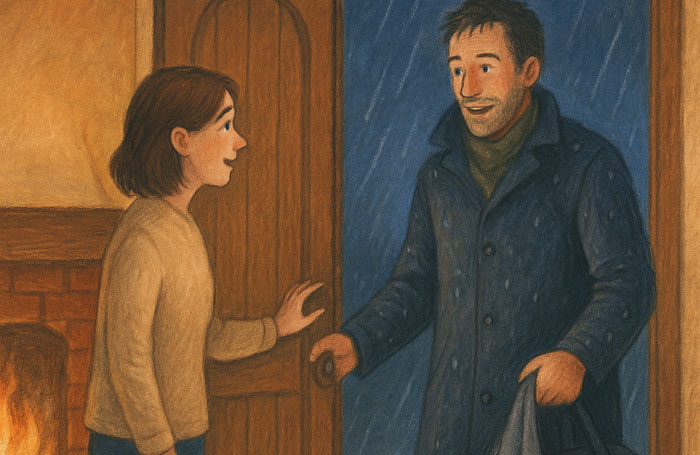
    It was a cold, rainy evening in November. Anna was sitting by the fire with a cup of tea when someone knocked at the door. She wasn’t expecting anyone. Slowly, she walked to the door and opened it.

    A tall man stood outside. He was wet from the rain and looked tired.
    “Good evening,” he said. “I’m sorry to bother you. My car broke down, and there’s no phone signal. Can I wait here until help arrives?”

    Anna hesitated. She lived alone in a small house in the countryside. But the man looked honest, and the storm was getting worse.

    “Of course,” she said. “Come in. You must be cold.”

    The man stepped inside and smiled. “Thank you. I really appreciate it.”

    Anna gave him a towel and made another cup of tea. They sat by the fire and talked. His name was Michael. He was a writer travelling to a town nearby for a book event. He spoke kindly and told funny stories. Anna felt relaxed.

    Hours passed, but no help came. The rain didn’t stop. Anna offered him the guest room.

    “You can stay the night,” she said. “It’s too dangerous to drive.”

    “Thank you,” Michael said. “You are very kind.”

    The next morning, the sun was shining. Michael’s car was gone when Anna woke up. On the kitchen table, she found a note:

    “Dear Anna,
    Thank you for your warmth and kindness. People like you make the world better. I hope we meet again.
    — Michael”

    Under the note was a signed copy of his book. On the first page, he had written:
    To Anna, the most generous host. Thank you for reminding me of the good in people.

    Anna smiled. It was just one evening, but it made a difference — for both of them.

    📒 Key vocabulary

    hesitate – to pause before doing something, often because you are unsure or nervous.

    appreciate – to be thankful or show gratitude for something.

    generous— willing to give or share with others; kind and unselfish.

    dangerous – not safe; likely to cause harm, injury, or problems.

    relaxed – calm and comfortable; not stressed or worried.

    🤔 Comprehension quiz

    How much of this story did you understand? Test yourself with this easyEnglish quiz!