
Advertisement

Home » B1 » Page 2

Level: B1

  • The Cheapskate

    The Cheapskate

    Charles Whitcomb was famous for one thing: his stinginess. His friends said he was careful. His coworkers said he was “very good with budgets.” But most people simply said the truth—Charles was cheap.

    He reused the same teabag until it looked like wet paper. He cut two‑ply toilet paper into single sheets to make it last longer. He unplugged his fridge every night because he believed cold air “stays inside.” When the city offered recycling bins for £5, Charles refused. Instead, he put old newspapers under his mattress, saying they kept his back straight.

    Saving money made him feel clever. It didn’t bother him that people avoided going out with him. His sister didn’t let him babysit anymore after he gave her children out‑of‑date yoghurt and called it “a lesson about wasting food”.

    One rainy Thursday, Charles walked home with his old umbrella, which only had half its ribs left. On a lamppost he saw a handwritten sign:

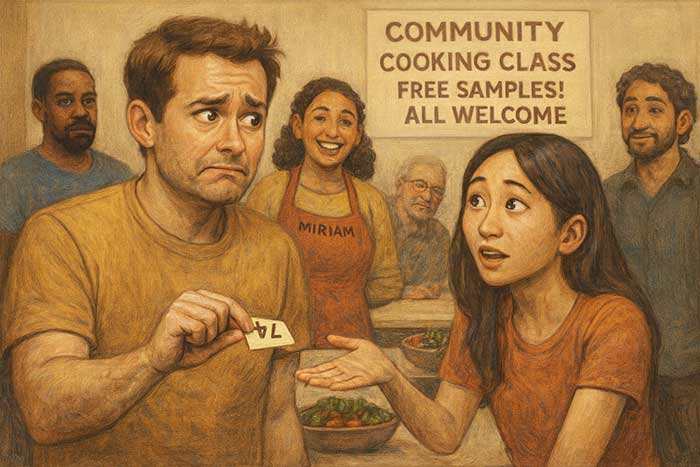
    COMMUNITY COOKING CLASS – Free Samples! All welcome!

    The word “free” made his heart beat faster. Free food… maybe free leftovers… paradise.

    Inside the community hall, people sat at long tables. A cheerful woman named Miriam taught everyone how to cook cheap and healthy meals. The warm room smelt of spices, vegetables, and fresh bread. Charles sat in the front row, notebook ready, like a soldier on a money‑saving mission.

    During the class, Miriam passed around small samples. Charles took one… then another… then, pretending to adjust his coat, a third. He slipped that one into his pocket for later. It squished a little, but he didn’t mind. It was free.

    At the end, Miriam announced a raffle.

    “The prize is one month of free vegetables from the community garden!”

    Charles almost shouted with joy. Free vegetables for a whole month meant almost no money spent on groceries.

    The raffle was “donation only”. Miriam said people could give £2… or more… or nothing at all. Charles quietly chose the final option. He took a ticket without putting in a single coin.

    Miriam pulled a ticket from the box. “The winner is… number 47!”

    Charles jumped up, waving his ticket. “That’s me!”

    But a quiet voice said, “I… I think it might be mine.”

    A thin woman in an old coat held her ticket carefully. Miriam checked. “Yes, she’s the winner!”

    Charles looked again. He had read his ticket upside down. It was 74.

    Everyone in the room giggled. Someone whispered loudly, “Typical Charles—trying to win for free.” More people laughed.

    His face burnt. He sat down, trying to look invisible, but things got worse.

    Miriam said warmly, “Let’s congratulate our winner… And thank Charles, who took three extra samples!”

    Everyone turned. A child pointed and shouted, “Mum! He’s got food leaking out of his pocket!”

    The tart in his pocket had melted into a greasy mess, leaving a big stain. People burst into laughter.

    Charles wanted to disappear.

    On his way out, embarrassed and sticky, he finally put £10 into the donation box. But as he turned to leave, he stepped on a vegetable peel, slipped, and fell straight into a large recycling bin full of cardboard. The door slammed behind him.

    Everyone gasped—then laughed harder than ever.

    It was, they agreed, the first time Charles had ever *given* anything to the community—and the first time he had been recycled.

    📒 Key vocabulary

    • stinginess – reluctance to spend money
    • two‑ply – two layers of paper
    • unplugged (unplug, unplugged, unplugged) – take out of an electricity socket
    • mattress – the soft part of a bed you sleep on
    • leftovers – food that is left from a previous meal
    • cheerful – happy and friendly
    • samples – small amounts of food to taste
    • raffle – a game where you buy a ticket and might win a prize
    • groceries – food and other essential items people buy
    • donation – money given to charity or a good cause
    • giggled (giggle, giggled, giggled) – laugh quietly to oneself
    • leaking – escaping from a container
    • melted (melt, melted, melted) – turn from solid to liquid due to heat

    🤔 Comprehension quiz

    How much of this story did you understand? Test yourself with this easyEnglish quiz!
  • The Break

    The Break

    Rachel pressed her forehead against the cold train window, watching the city fade into the distance. Her friends were chatting happily, but she barely listened. The break up with Tom had left her feeling empty—like someone had pulled the colour out of her world.

    Cheer up,” said Megan brightly. “This weekend away is exactly what you need.”

    Rachel forced a smile. “Unless it brings back my boyfriend or my Wi-Fi, I doubt it.”

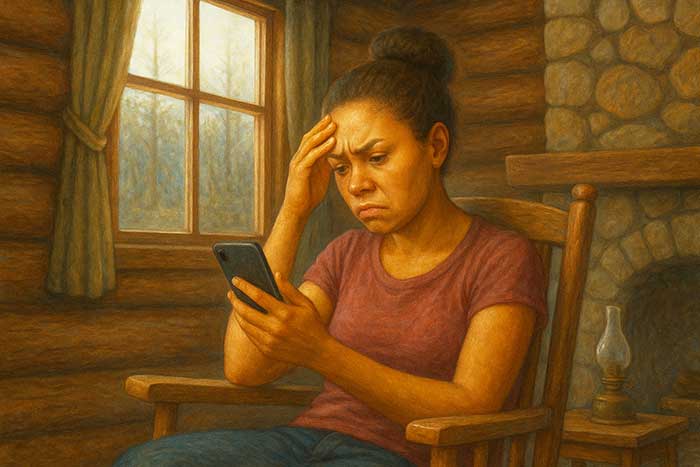
    Her friends laughed, but Rachel didn’t. She couldn’t stop checking her phone. Every time the screen stayed blank, her chest tightened. What if Tom changed his mind? What if he texted and she didn’t see it?

    When the taxi dropped them at the countryside cottage, Rachel’s heart sank. The place looked peaceful, almost too peaceful—no traffic, no shops, just silence and the smell of damp grass.

    She pulled out her phone immediately. “No signal,” she muttered. She walked in circles, waving it in the air like a magic wand. “Come on, come on…”

    Megan stepped forward carefully. “There’s something we should tell you. The cottage doesn’t have Wi-Fi.”

    Rachel stopped moving. “What do you mean no Wi-Fi?”

    “It’s a digital detox!” said Sarah, trying to sound cheerful. “No phones, no internet—just us, nature, and fresh air.”

    Rachel’s eyes went wide. “You dragged me to the middle of nowhere without mentioning that there would be no Wi-Fi?” Her voice rose with every word. “Do you have any idea what’s happening in my life right now? What if someone needs to reach me?”

    “Who?” asked Megan softly.

    The question hit like a punch. Rachel opened her mouth, then closed it again. She turned away, pretending to unpack her bag before her friends could see her tears.

    That first evening was torture. Every few minutes, she picked up her phone and stared at the screen, hoping for a miracle signal bar. When it stayed empty, she felt panic rising. She couldn’t text Tom. She couldn’t scroll. She couldn’t escape.

    That night, she lay in bed listening to the quiet. It wasn’t peaceful—it was deafening. Her thoughts rushed in like waves. What if Tom was already with someone else? What if everyone forgot about her? She wanted to scream.

    The next morning, she dragged herself out of bed. Her friends were already outside, laughing over breakfast. “Come on,” said Sarah. “We’re going hiking.”

    Rachel groaned but followed. The path led through thick woods and over a hill. Her boots were uncomfortable, her legs hurt, and she complained every five minutes.

    But then something changed. As she stopped to catch her breath, she noticed the sunlight through the trees, the smell of pine, and a small bird landing on a branch near her. The air was clean and sharp. She closed her eyes and, for the first time, her mind went quiet.

    Later, they reached a lake so still it looked like glass. Rachel knelt to touch the water and saw her reflection—tired, yes, but calmer.

    That night, sitting by the campfire, she laughed until her stomach hurt. She hadn’t laughed like that in months.

    “I hate to admit it,” she said, “but maybe this detox thing actually worked.”

    Megan smiled. “Sometimes, you have to lose connection to find yourself again.”

    Rachel looked up at the stars—bright, endless, and real.

    When she finally turned her phone back on two days later, the screen stayed dark for a moment, then lit up. No new messages. No calls.

    And, for the first time, she smiled.

    📒 Key vocabulary

    • fade (fade, faded, faded)- to slowly become less clear
    • cheer up (cheer up, cheered up, cheered up) – to start feeling happier
    • blank – empty; showing nothing
    • damp – a little wet or moist
    • muttered (mutter, muttered, muttered) – to speak in a low, complaining voice
    • detox – a time when you stop doing or using something unhealthy
    • dragged (drag, dragged, dragged) – to move someone / something heavy, often without their consent
    • torture – great physical or emotional pain
    • bar (on a phone) – the line that shows the strength of the signal
    • deafening – extremely loud or strong (used for silence that feels too powerful)
    • reflection – the image you see in a mirror or on water

    🤔 Comprehension quiz

    How much of this story did you understand? Test yourself with this easyEnglish quiz!

  • The Magician

    The Magician

    Milo the magician had been amazing audiences for nearly half a century. People loved his shows — the bright lights, the loud music, and, of course, his wonderful magic tricks. He could pull a rabbit from an empty hat, make coins disappear, and even float in the air. Every night, people clapped and cheered, shouting his name: “Milo! Milo! Milo!”

    But one evening, something strange happened. Milo stood on the bright stage, ready to do his famous card trick. He said the magic words — “Abracadabra!” — and waved his hand. Nothing happened. The card stayed in his fingers. There was no magic or surprise.

    The audience waited. Someone coughed. Milo smiled nervously and tried again. Still nothing. He moved on to his next trick, reaching into his tall black hat. Usually, a white rabbit would appear. But this time — nothing. The hat was empty.

    Milo’s heart started to beat quickly. He could hear people whispering in the crowd. He tried another trick, and another — but every single one failed. When the show ended, no one clapped. The lights dimmed, and Milo stood alone on the stage, feeling cold and confused.

    The next morning, Milo hurried to his workshop. It was full of magic things — old cards, shiny boxes, coloured scarves, and clever mirrors. He checked everything carefully. Nothing was broken. “Why isn’t it working?” he whispered. “Where has my magic gone?”

    For days, he practised from morning until night, but his tricks refused to work. His hands shook, his eyes were tired, and his heart was heavy. Maybe his time was over. Maybe the world didn’t believe in magic any more.

    One grey afternoon, Milo went for a walk in the park. He sat on a bench, thinking about his old shows. Then he noticed a little boy crying nearby.

    “Why are you sad?” Milo asked gently.

    “My balloon flew away,” the boy said. “It’s gone forever.”

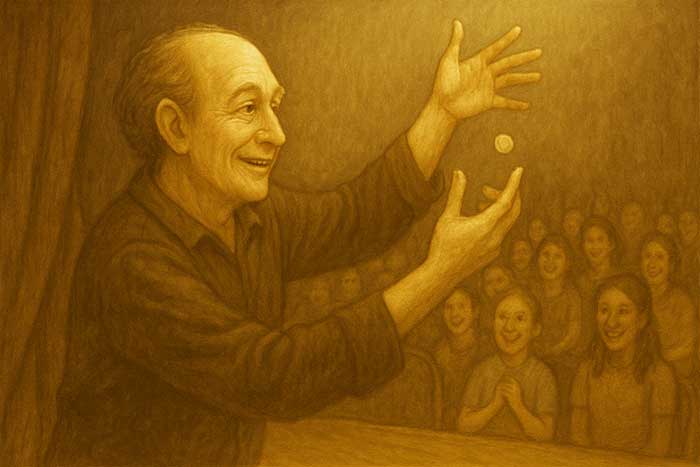
    Milo smiled softly. “Maybe not,” he said. He reached into his pocket, took out a small coin, and made it disappear. Then, with a wink, he pulled it from behind the boy’s ear. The boy gasped, then laughed with delight.

    “Wow! How did you do that?”

    Milo laughed too — a real, happy laugh. For the first time in weeks, he felt warm inside. “It’s a little magic,” he said.

    In that moment, Milo understood. His tricks had stopped working because he had forgotten what real magic was. It wasn’t about secret tools or clever moves. Magic was about joy — the joy he gave to others and the joy he felt in return.

    That evening, Milo returned to the theatre. The audience waited, curious. He didn’t use his old tricks this time. He told stories, made people laugh, and did simple magic with his hands — and his heart.

    When the show ended, the crowd stood up and clapped loudly. Milo bowed deeply, smiling. The real magic, he knew now, had never left him.

    It had been inside him all along.

    📒 Key vocabulary

    • audience – the people watching or listening to a show
    • trick – a skillful act, an illusion, performed to entertain
    • float (float, floated, floated) – to stay or move gently on top of a liquid or in the air
    • stage – the raised area in a theatre where actors perform
    • dim (dim, dimmed, dimmed) – make less bright or less clear
    • shiny – reflecting light
    • bench – a smooth seat that reflects light and looks bright or polished
    • gasp (gasp, gasped, gasped) – suddenly breathe in deeply, often from surprise or shock
    • crowd – a large group of people gathered together in one place
    • bow (bow, bowed, bowed) – bend the body forward as a sign of respect or thanks

    🤔 Comprehension quiz

    How much of this story did you understand? Test yourself with this easyEnglish quiz!
  • The House Swap

    The House Swap

    Lucy and Tom were tired of rainy English summers. This year, they wanted something different. While looking on a travel website, they found the ideal holiday – a house swap opportunity in California. The owners, Mark and Anna, seemed friendly in their messages. The house was large and modern, with a big pool in the garden. Everything seemed perfect.

    Lucy imagined sun, beaches, and long evenings on the terrace. Tom just wanted a break from work. They agreed quickly, packed their suitcases, and flew across the Atlantic to Mark and Anna’s luxury home.

    The Californian house was exactly like the photos—white walls, big windows, and a pool in the garden. It was bigger than their house in England. “It’s beautiful,” Lucy said, opening the curtains to the sea view.

    But on the first night, Lucy woke suddenly. She thought she heard someone walking upstairs. Tom checked every room, but there was no one. They laughed nervously and went back to bed.

    The next morning, they went shopping. When they returned, the front door was unlocked. Tom was sure he had locked it. Inside, nothing was missing, but Lucy noticed the chairs around the dining table had moved.

    “Maybe it was the wind,” Tom suggested, though he didn’t believe it himself.

    That evening, the phone rang. Tom answered, but there was only silence on the line before it clicked dead.

    On the third day, Lucy was watering the plants outside when a neighbour waved. “You’re back early,” she said with a friendly smile.

    Lucy frowned. “Sorry? I think you’ve made a mistake.”

    The woman looked surprised. “Aren’t you Anna? You and Mark told us you’d be away for a month.”

    Lucy froze. “No,” she said slowly. “I’m Lucy. We’re just staying here for a house swap.”

    The neighbour’s smile disappeared. “House swap? That’s strange. I saw Anna in the supermarket yesterday.”

    Lucy’s stomach turned cold. She thanked the woman and went inside. “Tom,” she whispered. “The neighbour thought I was Anna—and she says Anna was here a few days ago.”

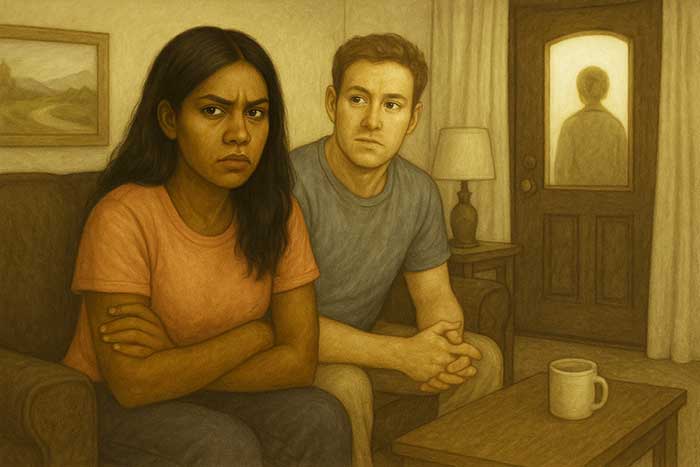
    They stared at each other. If the real owners were still in California… Who had been emailing them?

    That night, Lucy and Tom sat in the living room, too nervous to sleep. Suddenly, a shadow crossed the window. Then, the back door handle began to move slowly.

    Tom grabbed a heavy lamp. “Who’s there?” he shouted.

    The door opened, and a man stepped inside. He was tall, with dark eyes and a calm smile. “Relax,” he said. “This isn’t your house.”

    Lucy’s voice shook. “Who are you?”

    He ignored the question. “You should leave. Now.”

    Fear took over. Lucy and Tom didn’t wait. They grabbed their passports and ran to the car. Tom started the engine while Lucy looked back at the house. The man was standing at the window, watching them.

    They drove through the night to the airport and bought the first tickets back to London. They didn’t care about the money—they just wanted to be safe.

    Back in the UK, Lucy and Tom tried to forget what had happened. They told their friends it had just been “a holiday that went wrong.” But at night, Lucy often woke with the memory of the man’s calm smile.

    One morning, a letter arrived with no return address. Inside was a single photograph. It showed Lucy and Tom standing at the pool in California. They hadn’t noticed anyone taking a picture.

    Lucy dropped the photo on the table. “Tom,” she whispered, “do you think… he knows where we live?”

    Tom didn’t answer. He just looked at the photo, his face pale.

    That night, Lucy thought she heard footsteps again—this time in their house.

    📒 Key vocabulary

    • swap – exchange, trade one thing for another
    • terrace – an outdoor area next to a house, often with chairs
    • nervously – in a worried or afraid way
    • unlocked – not closed securely
    • frown (frown, frowned, frowned) – move eyebrows together to show confusion or worry
    • handle – the part of a door that you hold
    • shake (shake, shook, shaken) – move involuntarily due to fear
    • calm – relaxed, not worried or excited
    • pale – white, without colour

    🤔 Comprehension quiz

    How much of this story did you understand? Test yourself with this easyEnglish quiz!
  • The Flatmate

    The Flatmate

    Emma felt lucky to have found a place to live so quickly, and this flat seemed perfect. It was small but bright, on a quiet street near the park. After her recent breakup with her boyfriend, she wanted a new start, away from all the things that reminded her of her old life.

    She had found the place through an online ad which said, “Room to rent. Must like peace and privacy.” It sounded perfect.

    When she arrived to see the flat, Daniel opened the door. He was tall and polite, with a calm voice. The flat was clean and tidy, with books on the shelves and the smell of coffee. “It’s quiet here,” Daniel said. “I work from home, so I like things to stay that way.” He seemed kind and trustworthy. Emma moved in the next week.

    At first, everything was excellent. Daniel was friendly but not too talkative. He made tea for both of them in the evenings, and they sometimes watched TV together. Emma told her friends that she was finally feeling safe again. But after a few weeks, strange things began to happen.

    One morning, her phone was not where she had left it. Another day, her laptop said, “Password changed successfully.” She was sure she hadn’t changed it. When she asked Daniel, he laughed softly. “You probably forgot,” he said. “You’ve been under stress.”

    Emma wanted to believe him, but soon she noticed more strange things. Her bedroom door, which she always locked, was sometimes open when she came home. She often heard quiet footsteps in the hallway late at night. Once, when she woke up suddenly, she saw a shadow move outside her door. Her heart beat fast, but when she opened it, the hallway was empty.

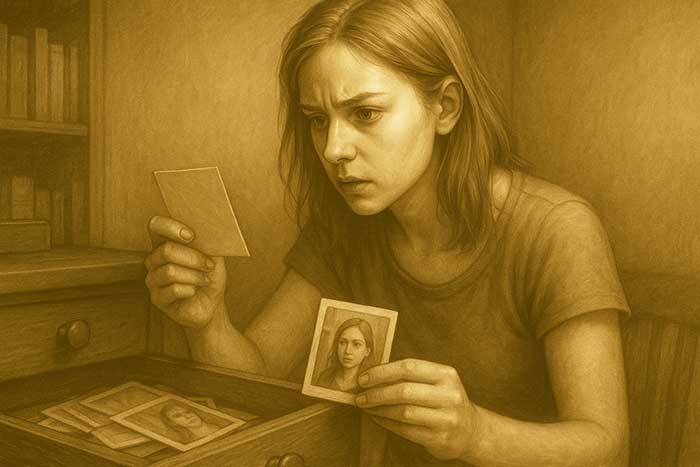
    A few days later, Emma found something that made her feel sick. While looking for a charger, she opened a drawer in the living room. Inside were printed photos—of her. Some were from before she had moved in, taken from far away, near her old flat and at the park. Her hands started to shake. When Daniel came in, she quickly closed the drawer.

    He smiled as if nothing was wrong. “You shouldn’t look through other people’s things, Emma,” he said quietly. “That’s not polite.” His eyes stayed on her a little too long.

    That night, Emma couldn’t sleep. She decided she had to leave, but she was afraid. Daniel knew her passwords and had copies of her keys. So, she made a plan. The next day, she told him she was visiting a friend for the weekend. He smiled again. “Of course. Have fun.”

    When he went out to buy food, she packed her bag, grabbed her passport, and ran. She didn’t look back. From a café nearby, she called the police and told them everything.

    Two days later, they arrested Daniel. He wasn’t who he said he was. The real Daniel had disappeared years ago. The man Emma had lived with had another name — and a history of following women.

    Weeks passed before Emma could sleep properly again. She moved to a new city and found another flat — this time, she lived alone. But sometimes, when she looked at her phone, she saw a message from someone she didn’t know. 

    The profile picture was always the same: a photo of a quiet street and a door that looked very much like hers.

    📒 Key vocabulary

    • flat – an apartment; a place to live in a building
    • ad – short for advertisement; a notice about something for sale or rent
    • tidy – clean and organized; not messy
    • trustworthy – someone you can trust; honest and reliable
    • footsteps – sounds made by someone walking
    • hallway – a long passage inside a building connecting rooms
    • shadow – a dark shape made when something blocks light
    • drawer – a box-shaped part of furniture that slides out to store things
    • shake (shake, shook, shaken) – move slightly because of fear or emotion
    • arrest (arrest, arrested, arrested) – take to prison because of a possible crime

    🤔 Comprehension quiz

    How much of this story did you understand? Test yourself with this easyEnglish quiz!
  • The Money Tree

    The Money Tree

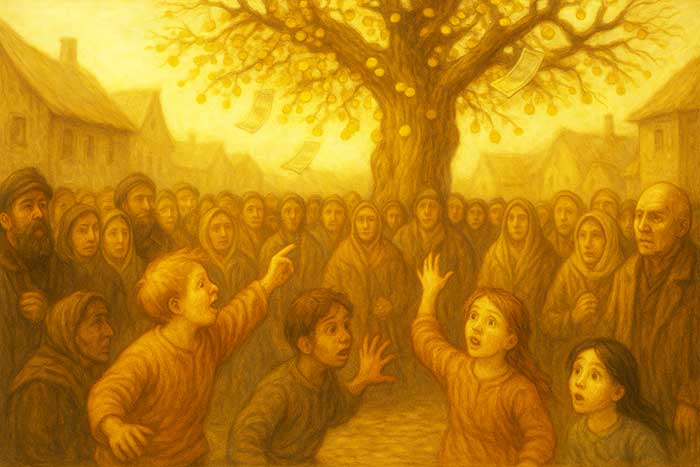
    One summer day, the people of Newton Village woke to strange news. Children ran through the streets shouting, “Come and see! Come and see!” Neighbours opened their doors and hurried to the square. Where an old apple tree had stood for many years, a new tree had grown. But this was not a normal tree. On its branches were coins instead of leaves, and paper notes moved slowly in the wind. In the morning light, the tree looked full of money, and the villagers stared wide-eyed.

    At first, people were delighted. Tom the baker took a few coins to buy flour. Anna the teacher took just enough to fix her roof. Maria, the mother, picked one note to buy medicine for her child. Life felt fair, and the people smiled at one another. The tree gave hope, and for a short time the village was full of peace.

    But soon, greed began to grow. Peter the shopkeeper brought a large bag and filled it with money. Lucy, the farmer, climbed the tree and broke its branches. Neighbours pushed each other in the square. People argued and shouted. Friends stopped talking. Families began to fight.

    Old Mr Green, who had cared for the apple tree before it died, tried to warn them. He said, “If you take too much, the tree will not live.” But nobody listened. Day after day, the people pulled more and more money from the tree. The coins lost their colours. The paper money tore and fell apart. At last, the tree stood with no money and no leaves, only broken wood.

    The people were unhappy, the square was empty, and the tree was dead. The money had disappeared. But worst of all, their kindness had disappeared too. Tom no longer helped his customers. Anna no longer spoke to her neighbours. Maria ate alone with her child.

    From that day onwards, the dead tree stayed in the square. Children asked, “Why is the tree like that?” And the parents had to answer, “Because we were greedy, and we forgot to share.”

    The children of Newton Village listened carefully. They promised each other that when they grew up, they would not make the same mistake.

    📒 Key vocabulary

    • branches – parts of a tree that grow from the trunk or from another branch; can also mean divisions or sections of an organization
    • notes – paper money issued by a bank that is used as currency
    • wide-eyed  – with astonishment
    • flour – a powder made by grinding grains (especially wheat), used in baking and cooking
    • greed – an intense and selfish desire for something, especially wealth, power, or food
    • warn (warn, warned, warned) – to tell someone about possible danger, trouble, or a problem so they can be careful or prepared
    • tear (tear, tore, torn) – the past tense of “tear”; to pull something apart forcefully
    • greedy – having or showing an intense desire for more than is needed or fair, especially wealth or food

    🤔 Comprehension quiz

    How much of this story did you understand? Test yourself with this easyEnglish quiz!
  • Tweet

    Tweet

    Most people in town noticed Ed’s anger before his smile. He had always been a little cross with the world, but since his wife had died the month before, his mood had grown much darker. The house felt too big, the silence too heavy. He spent his days in his chair, staring at the garden without really seeing it, and at night he complained to himself about the cold sheets.

    One afternoon, while he was reading the newspaper, there was a sudden thump against the window. Ed jumped. He went to look and saw a small bird lying still on the ground. “Stupid thing,” he said. “Can’t even see where it’s flying.” He opened the door, ready to tell it to go away. But when he bent down, he noticed the bird’s wing was hanging strangely. It was hurt.

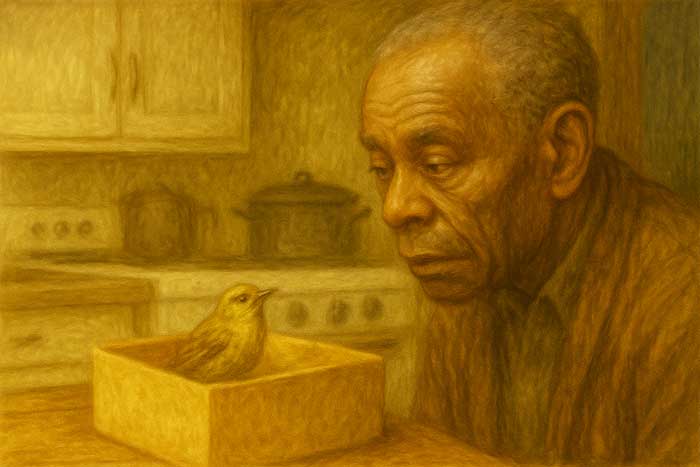
    Ed frowned. “This is all I need,” he said, but he couldn’t just leave it. He phoned the local animal home. A calm voice answered, “We can come tomorrow, sir. Just keep the bird safe until then.” Ed sighed loudly but went back inside, found an old box, and put the bird gently inside. He placed the box on the kitchen table and shook his head. “Don’t get used to it. Tomorrow you’re gone.”

    The next morning, there was a bad storm. Rain hit the glass, and the wind roared through the trees. At lunchtime, the animal home called. “I’m sorry, sir, but we can’t come today. The roads are closed.” Ed banged the phone down. “Great. Now I’m running a hotel for birds.”

    That afternoon, while he was half asleep in his chair, he suddenly heard music. At first, he thought it was the radio. But no, it was coming from the kitchen. His heart gave a strange jump—the tune was familiar. It was the song his wife used to sing while she cleaned the house. Her voice had filled every corner, light and cheerful, and Ed had not heard it since she passed.

    He hurried into the kitchen and froze. The bird was standing in the box, its small chest moving quickly as it whistled the melody. Ed sat down slowly. “Impossible,” he whispered. Yet the tune was clear, note for note, just as his wife had sung it.

    That evening, Ed tore a piece of bread and offered it. The bird pecked at it and then, as if in thanks, sang the song again. Ed listened with wet eyes. For the first time in weeks, his house did not feel empty. He smiled for the first time in a long while. “I’ll call you Tweet,” he said softly.

    The storm went on for days, and each day Tweet sang. Sometimes it hopped across the kitchen table in a way that reminded Ed of his wife moving about the room. He began to talk to it as if it could answer. Slowly, the weight on his chest began to lift.

    When the weather finally cleared, the animal home called again. “We can collect the bird today.” Ed looked at Tweet, who was now much stronger. He smiled. “No, thank you,” he said firmly. “I’ll look after it myself.”

    In time, Tweet became able to fly again. But it never left him. Each morning it returned, landing by the window, singing the same song. Ed was no longer lonely. Each note reminded him that love had not left his house—it had simply found a new voice.

    📒 Key vocabulary

    • cross – a little angry or unfriendly
    • frown (frown, frowned, frowned) – make a serious or unhappy face
    • roar (roar, roared, roared) – make a very loud, deep sound
    • freeze (freeze, froze, frozen) – stop suddenly
    • whistle (whistle, whistled, whistled) – make a high musical sound by blowing air
    • melody – a song or tune
    • peck (peck, pecked, pecked) – hit or eat with the beak (bird’s mouth)
    • hop (hop, hopped, hopped) – jump up and down
    • weight on his chest – a heavy feeling of sadness

    🤔 Comprehension quiz

    How much of this story did you understand? Test yourself with this easyEnglish quiz!
  • Younger

    Younger

    Rita’s fortieth birthday was approaching, and she wasn’t feeling happy about it. Every time she looked in the mirror, she saw grey hairs and lines around her eyes. When she touched her skin, it no longer felt smooth. Other women in the street looked young and full of life, but Rita only felt older each day. She wanted to look young again, no matter what it cost.

    One day, she read about an old woman in the town who could make special creams and drinks. People said the woman’s cream could stop ageing and make you look younger. Rita was curious. She visited the woman in a small dark house at the end of the street.

    The woman smiled and gave her a small jar. “Use this cream every night,” she said. “It will make you feel young again. But remember—never stop using it.”

    Rita went home and put the cream on her face. When she looked in the mirror the next morning, she started crying with happiness. Her skin was smooth. The lines were gone. She looked twenty-five. She laughed and danced around the room.

    Every day, she used the cream. People at work said, “Rita, you look wonderful! What is your secret?” She only smiled. Inside, she was proud. She was young again.

    But after a few weeks, strange things started to happen. At night, she felt her skin burning. Occasionally, she woke up with scratches on her face. Once, she saw a shadow move across the mirror when she was alone.

    Rita went back to the old woman. “Something is wrong,” she said.

    The woman looked at her with cold eyes. “You wanted youth. The cream takes something in return.”

    Rita felt afraid. “What does it take?”

    The woman whispered, “Take your time.”

    That night, Rita stared at herself in the mirror. She still looked young, but her eyes were dark, and her smile seemed strange. She put the cream back on her skin. She could not stop—she remembered the warning.

    Days passed. Rita’s body felt weak, even though her face looked young. She needed more and more sleep. When she walked, her legs shook. Her friends asked, “Are you sick?” but she only smiled. She could not tell them.

    One evening, Rita dropped the jar. The last of the cream spilt onto the floor. She screamed. She tried to put it back into the jar, but it was gone.

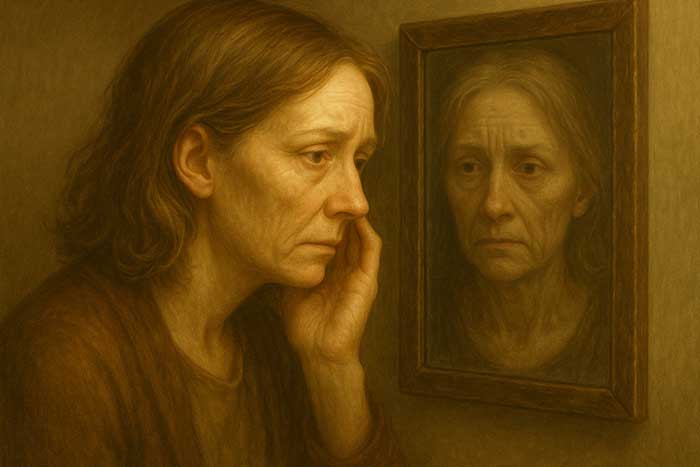
    That night, she went to bed without the cream. At midnight, she woke up to a terrible pain. Her skin was changing. Wrinkles appeared on her face. Her hair turned white. She felt her body grow smaller, weaker, older.

    She ran to the mirror and saw an old woman, a stranger she didn’t recognise. The eyes were hollow, and the mouth was dry and thin.

    Rita screamed again, but no sound came out.

    The next morning, the neighbours found her house empty. On the table, they saw a broken mirror and a photo of Rita smiling when she was young. But no one ever saw Rita again.

    📒 Key vocabulary

    • creams – soft, thick liquids you put on your skin
    • ageing – the process of getting older
    • curious – wanting to know or learn something
    • scratches – thin marks or cuts on the skin or surface
    • shadow – a dark shape made when something blocks the light
    • youth – the state of being young
    • whisper (whisper, whispered, whispered)  – speak very quietly, with a soft voice
    • warning – words that tell someone to be careful about danger
    • weak – not strong
    • shook (shake, shook, shook) – move up and down or side to side quickly
    • spill (spill, spilt, spilt) – when liquid falls out of a container by accident
    • wrinkles – small lines on the skin that come with age
    • hollow – empty inside

    🤔 Comprehension quiz

    How much of this story did you understand? Test yourself with this easyEnglish quiz!
  • The Old Phone

    The Old Phone

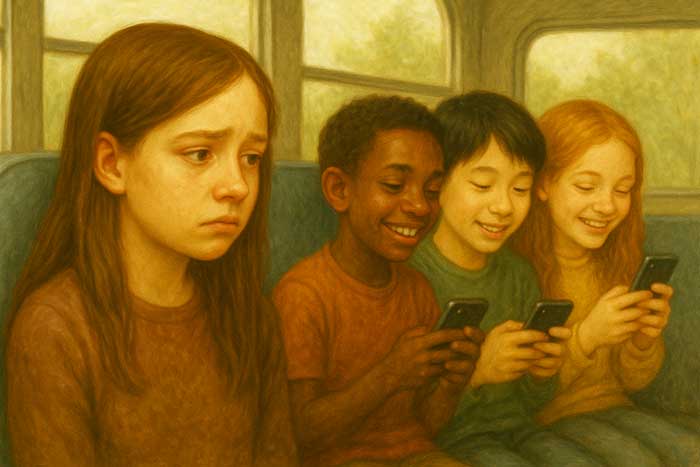
    Jenny sat on the school bus, staring sadly at her classmates. They all had shiny new smartphones, which she knew cost a lot of money. Together, they played games, watched videos, and sent photos to one another. They were all having so much fun and Jenny felt left out.

    She wished she could join in. But she didn’t have a phone—at least not a phone like theirs. Her mum had saved for weeks and finally bought her a second-hand phone from a small shop in town. It was old, with a tiny screen and big buttons. It couldn’t take pictures or go on the internet. The only game was “Snake”.

    Jenny tried to be grateful, but every time she saw her friends’ phones, she felt sad. She wished she could have one of the new ones, the kind that made you feel like you belonged.

    That night, she sat on her bed, holding the old phone in her hand. She pressed the button for messages. To her surprise, a message appeared on the screen. But no one even knew her number.

    The message said, “Need help? Look outside.”

    Jenny ran to the window. Across the street, an old woman was carrying two heavy bags. Jenny rushed out to help. When she came back, the phone buzzed softly. A new message appeared on the screen: “Good job.”

    The next day, Jenny wrote, ‘What should I do?’

    The phone answered instantly: “Go to the back of the school.”

    Jenny went there at lunch and found a tiny kitten in a box. She lifted it carefully and smiled. Again the words appeared: “Good job.”

    Over the next few weeks, the phone guided her to help more people. She found a boy’s lost wallet, warned a teacher about water on the floor, and even called an ambulance when an old man fell in the park. Each time, the phone rewarded her with the same words: “Good job.”

    Her friends still laughed at her. “Why don’t you have a real smartphone, Jenny?” they asked.

    Jenny just smiled. Her phone wasn’t new, but it was special.

    One evening, her mum saw her holding it and smiling. “You like that phone now, don’t you?”

    Jenny nodded. “Yes, Mum. It’s very special.”

    Her mum kissed her head. “Sometimes the best things aren’t the newest.”

    Jenny looked at her phone. She knew she would never trade it for anything—not even the most expensive smartphone in the world.

    📒 Key vocabulary

    • smartphones – modern phones that have small computers inside and can do many things
    • left out – excluded, not a part of something
    • second-hand – not new; owned or used by someone else before
    • screen – the flat surface on a phone, computer, or TV where you see pictures and words
    • buzz (buzz, buzzed, buzzed) – to make a low, vibrating sound like “bzzzz” (for example, when a phone vibrates)
    • kitten – a baby cat
    • wallet – a small case for money and cards
    • warn (warn, warned, warned) – to tell someone about danger or something bad that might happen so they can be careful
    • ambulance – a special car that takes sick people to hospital
    • trade (trade, traded, traded) – to give something and get something else back

    🤔 Comprehension quiz

    How much of this story did you understand? Test yourself with this easyEnglish quiz!
  • The End of the Line

    The End of the Line

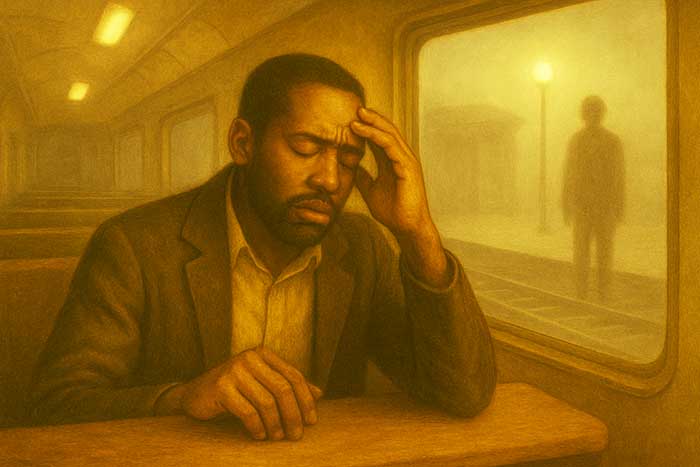
    Ben opened his eyes. His head hurt and his body felt heavy. It was Friday night, and he had been at the pub with his friends. As usual, he’d drunk too much beer and then fallen asleep on the train.

    However, this time something felt different.

    The carriage was silent. Ben sat up and looked around. Every seat was empty. No people, no voices, no footsteps. Only the sound of the train on the tracks.

    Something felt wrong. The train should have stopped already. It should have reached the last station. He pulled out his phone, but the screen was black. It did not work.

    The train slowed down. Then it stopped. Ben stood and held the rail. He looked out the window. There was a platform with a few weak lights. The place looked old and strange.

    He stepped out. The doors closed behind him. When he turned, the train was gone. It had disappeared into the dark tunnel.

    The platform was long and empty. No people, no shops, no signs. Only one big board above him. It had no name, no letters—just a blank board.

    “Hello?” Ben called. But nobody answered.

    Then he heard it. Step. Step. Step. The sound came from the far end of the platform.

    He tried to see what it was, but he was too far away. A shape moved slowly toward him. At first it looked like a man. But as it came closer, Ben realised it was not human. The body was thin. The arms and legs were too long. The head moved from side to side in a strange way.

    Ben frowned, too scared to say anything. He stepped back.

    The board above him lit up.

    LAST STOP, the letters read.

    Then the words disappeared. The board was blank again.

    The shape came closer. Its hand reached out. The fingers were long and sharp.

    Ben opened his mouth to scream—

    Suddenly, a hand touched his shoulder.

    “Sir, wake up!” a voice said.

    Ben’s eyes opened wide. He was on the train again. The lights were bright. A man in uniform stood in front of him. The conductor.

    “You slept the whole way,” the man said with a small smile. “We are at the end of the line. Time to get off.”

    Ben’s heart beat quickly. He looked around. The carriage was normal again—bags, bottles, papers. No shadow, no strange board, no shape.

    He stood up, legs shaking, and walked out into the cool night air. He touched his head.

    It was a dream, he told himself. Just a dream.

    But when he closed his eyes, he thought he could still hear footsteps following behind him.

    📒 Key vocabulary

    • carriage – one of many parts of a train in which passengers sit
    • tracks – the metal rails that trains run on
    • rail – a metal bar you can hold for support
    • platform – the flat area beside a train where people get on or off
    • weak – not strong; easy to break or hard to see
    • tunnel – a long, dark passage under the ground or through a hill
    • blank – empty
    • frowned (frown, frowned, frowned) – make a serious face by pulling the eyebrows down
    • conductor – the person who checks tickets and helps people on a train
    • shadow – a dark shape made when light is blocked

    🤔 Comprehension quiz

    How much of this story did you understand? Test yourself with this easyEnglish quiz!