
American accent
It was John who noticed the silence first. No music coming from his son’s room, no footsteps on the stairs, and no arguments about who would wash the dishes. His wife, Ann, was standing by the window, watching the grey clouds move across the winter sky.
“They’re really not coming home,” she said.
Both their children had called earlier that week. One was working abroad; the other had promised to spend Christmas with his girlfriend and her family. John and Ann understood, but the empty house felt strange. After years of noisy holidays, this one suddenly looked long and cold.
That evening, Ann made a suggestion. “What if we don’t stay here?”
John looked up. “You mean… go away?”
“Somewhere warm. Just this once.”
Two days later, they booked a last-minute trip to a tropical island far from Europe. They told themselves it was an adventure, not an escape.
The island was beautiful but simple. Their hotel stood close to the ocean, with wooden walls and narrow paths between palm trees. There was no television in the room, and the internet was weak. John liked that. It forced him to slow down.
Christmas Eve passed quietly. They walked along the beach and ate grilled fish in a small restaurant. The sea was calm, the sky clear. Ann slept well that night, listening to the waves.
On Christmas Day, the heat felt heavier. By midday, the air was thick and still. John noticed the ocean looked different — darker, restless. Around three o’clock, a strong wind suddenly rushed through the hotel grounds, knocking over chairs.
Soon after, the manager gathered the guests. “A tropical storm has changed direction,” he said. “It may hit us tonight.”
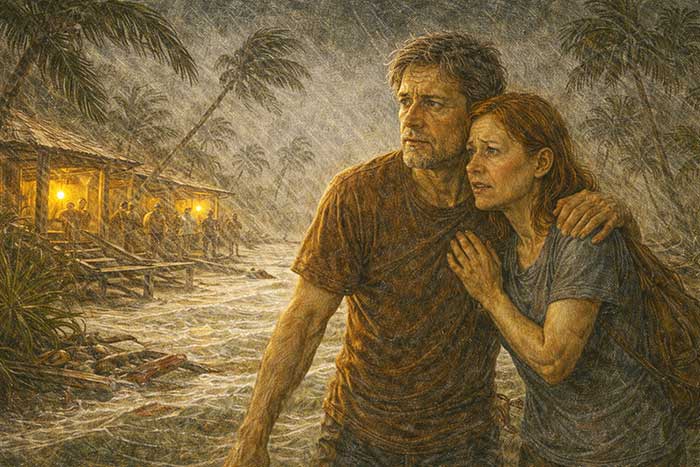
Rain started before sunset. Not gentle rain, but sharp and fast, driven by the wind. By evening, the storm had grown violent. The power failed, and the hotel shook with the strong force of the wind. The sound of the ocean was no longer calm; it was wild.
Guests were moved into the strongest building. Someone cried. Someone else shouted into a phone that had already lost signal. John felt Ann’s hand tighten around his arm.
At midnight, they hear a loud crash. A palm tree had fallen across one side of the hotel. Water poured inside, flooding the floor. Staff shouted instructions. People moved quickly, carrying bags, helping each other through the darkness.
For a moment, John felt real fear—not panic, but he realised that things were out of control. He thought of home, of their children, of how far away they were. Ann caught his eye. She was pale but calm.
“We stay together,” she said.
The storm reached its worst just before dawn. Wind howled around the building, and rain came in through the broken windows. Then, slowly, it began to weaken. By morning, the rain had stopped.
Outside, the island looked broken. Trees lay across paths. Boats were pushed far onto the sand. Parts of the hotel roof were gone. There was no electricity, no clean water, and no clear plan.
Flights were cancelled. Boats could not leave. Everyone was stuck.
Instead of panic, something else happened. Guests helped the staff clear debris. Food was shared. Someone found a guitar. John worked alongside a young couple and an old man who joked nonstop. Ann helped in the kitchen, cutting fruit and boiling water.
By evening, phones briefly connected. Ann sent one short message to their children: Storm. We’re safe.
That night, they sat outside under a sky full of stars. The island was quiet again, but different. And though his body was tired and sore, John felt strangely alive.
“This wasn’t the Christmas we planned,” Ann said.
“No,” John replied. “But I won’t forget it.”
They returned home days later, carrying damp clothes and strong memories. The house was still quiet — but it no longer felt empty.
📒 Key vocabulary
- abroad – in another country
- tropical – located between the Tropic of Cancer and the Tropic of Capricorn
- paths – small tracks which people to walk on
- restless – unable to relax or stay still
- tropical storm – a strong storm with heavy rain and wind
- violent – very strong and dangerous
- shook (shake, shook, shaken) – move involuntarily
- flooding (flood, flooded, flooded) – covering places that are usually dry with water
- pale – white, or extremely light in colour
- dawn – when the sun rises
- howled (howl, howled, howled) – make a loud aggressive sound like a dog
- debris – broken pieces left after damage
- nonstop – without stopping
- sore – painful or aching
- damp – slightly wet
🤔 Comprehension quiz
How much of this story did you understand? Test yourself with this easyEnglish quiz!

Leave a Reply